A customer of Crunchbase, a Middle East-based venture investment firm that wishes to remain anonymous, invests in emerging and growth stage technology companies and identifies promising opportunities across global markets.
The firm has a collaborative investment team that manages everything from deal sourcing and due diligence to portfolio management. Before using Crunchbase, they sought to strengthen its research capabilities and bring more sophisticated, AI-powered intelligence into its investment workflows.
The firm’s operations lead oversees the adoption of tools and internal platforms that support the investment team’s research and diligence workflows.
Two pressures were shaping how they approached data and tooling:
Like many venture capital firms, the team was exploring ways to bring more AI into its investment workflows. They began evaluating Crunchbase as a data source for an internal agent that could surface company profiles, funding and valuation history, investors, peer comparisons, and forward-looking signals through a conversational interface.
To streamline a previously manual deal analysis and due diligence process, the internal agent runs on a templated prompt: point it at a company, and it returns accurate core data points needed to answer common diligence questions, saving valuable time given the team’s high deal volume.
The agent is built to query both the Crunchbase and PitchBook APIs, letting the team cross-check foundational company data between the two sources while adding Crunchbase’s proprietary predictive intelligence to the analysis. With Crunchbase’s trusted private company data and predictions powering the agent, they can generate richer outputs that not only answer what’s known about a company today, but help assess where it may be headed next.
For the team, getting more value from AI meant giving its agent access to as much high-quality, relevant data as possible. Rather than relying on a single source, the team wanted Crunchbase to complement the data already powering its workflow and provide another way to cross-check critical company and deal information.
During the evaluation, the firm compared roughly a dozen companies across Crunchbase and PitchBook. The goal wasn't to determine which provider had the most data overall, but whether Crunchbase could add meaningful information the team didn't already have. It did: the firm found companies and individual data points available through Crunchbase that were missing from its existing source — particularly valuable given how difficult private investment data can be to uncover.
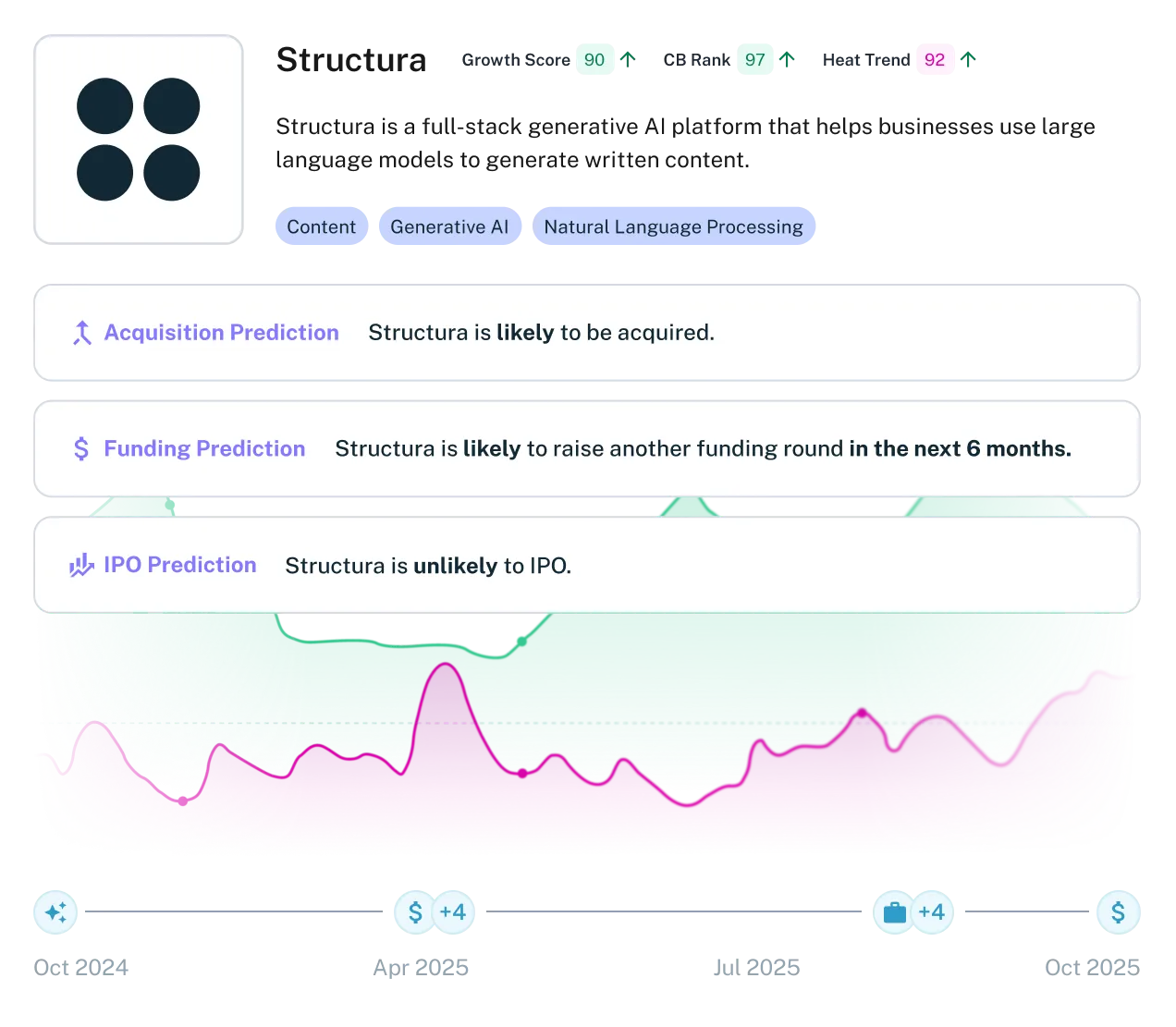
What ultimately set Crunchbase apart for the team was not just the additional data it could bring into their workflow, but an entirely untapped layer of intelligence: Predictions and Insights.
Crunchbase uses its depth of private company data to surface forecasts on outcomes like funding, growth, acquisitions, and IPOs. For the firm, that offered something particularly valuable when evaluating growth-stage companies: another data point for identifying which opportunities may be gaining momentum before that trajectory becomes obvious.
Importantly, they don’t treat a Prediction as an investment recommendation. During its evaluation, the Crunchbase team walked the firm through live model performance, giving the team visibility into how Predictions perform against actual outcomes. For this investment leader, their value is in adding another signal to a decision that will always require deeper quantitative and qualitative diligence.
“We know very well that a forecast could be wrong. We would never look at a high probability and say, ‘we’re going to invest because of that.’ That’s the nature of venture — there are so many qualitative factors you still need to understand. But Crunchbase’s Predictions give us an information advantage so we can act on a company before the market has priced in its potential. In this business, that timing can be the difference between getting in early and missing the round entirely" the leader explained.
For a firm evaluating a high volume of early-stage companies with limited historical data, having predictive signals also gives the team an early indicator of which deals to prioritize first.
"When we have a heavy volume of deals coming through, a strong prediction from Crunchbase is exactly the kind of signal that stands out. It tells us: this company may be worth prioritizing, because the outlook on where they're headed looks genuinely promising," explains an investment team representative at the company.
The firm found that standing up the Crunchbase API was straightforward, describing the process as "seamless.”
Today, the API is the team's primary point of use, powering the internal agent. The platform UI still gets regular use in live settings — for example, pulling up a company's full profile during a meeting for a quick, at-a-glance view, with Predictions and Insights visible front and center.
Since bringing Crunchbase into their workflow, the firm has seen its diligence process transform in four key ways:
By combining trusted private company data with forward-looking intelligence, Crunchbase is helping the firm build a faster, richer early deal evaluation process — giving the team more information to work with, an earlier signal on where to focus, and more time for the deeper diligence that ultimately drives investment decisions. Learn more about Crunchbase for investors and the Crunchbase API.



"Crunchbase has impressive regional coverage and gives us access to hard-to-find data."

"The heat scores and Funding Predictions ensure we’re focusing on the right opportunities."

"Crunchbase is a critical tool for sourcing high-quality leads. "