PitchBook vs. Crunchbase: Which Is Right for You?

9 min read
.svg)

Crunchbase is a private market intelligence solution used by investors, financial services teams, and market analysts to get the earliest view of the private market, understand it in full depth, and act quickly on revenue-driving opportunities. That's a different platform from the one PitchBook still describes.
PitchBook characterizes Crunchbase as a “sales prospecting tool” — a lighter weight database, useful for lead lists but not for serious research or due diligence. That description is far from accurate. Crunchbase offers more robust early stage coverage, product-level intelligence that goes far beyond a company profile, and predictive models across the full private company lifecycle. PitchBook is behind on all three counts, documenting historical, lagging company records instead of emerging opportunities and forecasts.
Here's what a current, accurate comparison looks like.
Crunchbase tracks 264,112 early stage companies globally, including angel, pre-seed, and seed-funded companies — 16% more than PitchBook. That gap extends globally: Crunchbase's advantage is 16% more early stage companies in the US, 11% more in Europe, and 31% more in Asia.
Those additional early stage companies represent real activity PitchBook hasn't picked up yet. For a team sourcing at the earliest stage, that blind spot is a missed window on exactly the companies worth watching first.
Coverage alone isn't enough if it's stale. Crunchbase's data refreshes 25.3% quarter-over-quarter — more than double PitchBook's 12.4% growth rate — so your team is consistently working from current signals, not a snapshot that's already behind. In addition, Crunchbase surfaces 4.9x more companies globally within three months of their raise, a gap that grows to 11.6x over six months.
Crunchbase also tracks 1.7x more AI companies than PitchBook, 2.4x more in robotics, and 3x more in cybersecurity.
With deeper, earlier, and fresher coverage, Crunchbase surfaces the companies worth watching and keeps that picture current as the market moves.
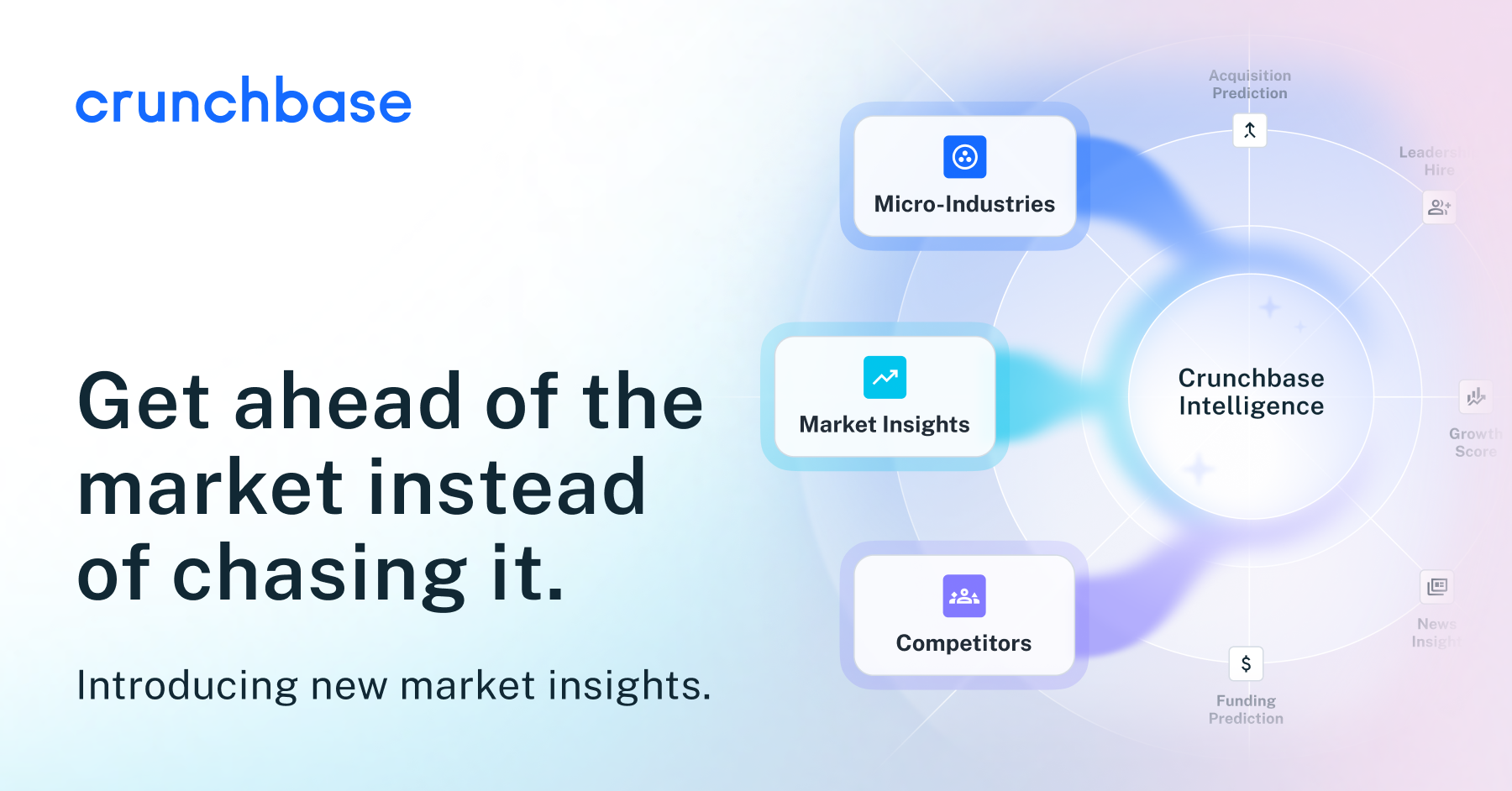
PitchBook’s company profiles answer the question: what does this business claim to be? Crunchbase answers three more useful ones: what does this company build, who does it compete with, and can you trust the answer to either?
Start with what a company builds. Crunchbase maps 19.8 million products and services across more than 5,200 micro-industries and 2.7 million organizations. That's a fundamentally different structure than a fixed industry vertical. A static category label tells you what bucket a company was assigned to at some point in the past. A dynamic, product-level taxonomy tells you what a company actually does today — and lets that classification update as the company itself evolves, rather than staying frozen at whatever category it was first filed under.
That same product-level structure is what makes Crunchbase’s competitive analysis work so well. Crunchbase's Similarity Engine maps 2.8 million organizations for comparative analysis, surfacing true lookalikes based on what companies build and who they compete with, not just a shared industry tag. PitchBook has no comparable scalable approach here; it relies on manual curation and fixed, hand-built lists that lag behind fast-moving, emerging niche markets. A rigid, manual list can't tell you which five companies just became your client's competitive set this quarter. A live, product-level taxonomy can.
To gather this intelligence, Crunchbase ingests, grades, verifies, and activates data across five distinct sourcing types — including 5.2 billion derived intelligence signals, 1.9 billion behavioral data points, and 1.1 billion third-party records — with more than 400 algorithms validating, deduping, and scoring that data daily. PitchBook frames Crunchbase's data model as "user-submitted" and unreliable, which skips over the verification layer entirely. It's a convenient thing to skip, since it lets PitchBook avoid describing its own contributor process in the same detail it demands of everyone else's.
PitchBook doesn't attempt to make private market predictions at scale. Its predictive suite is limited to two models — valuation and exit — which leaves funding, growth, and risk entirely uncovered.
Crunchbase, on the other hand, runs seven prediction types across the full private company lifecycle — funding, growth, acquisition, IPO, remain private, layoffs, and closures — generating and refreshing 15 million predictions every week.
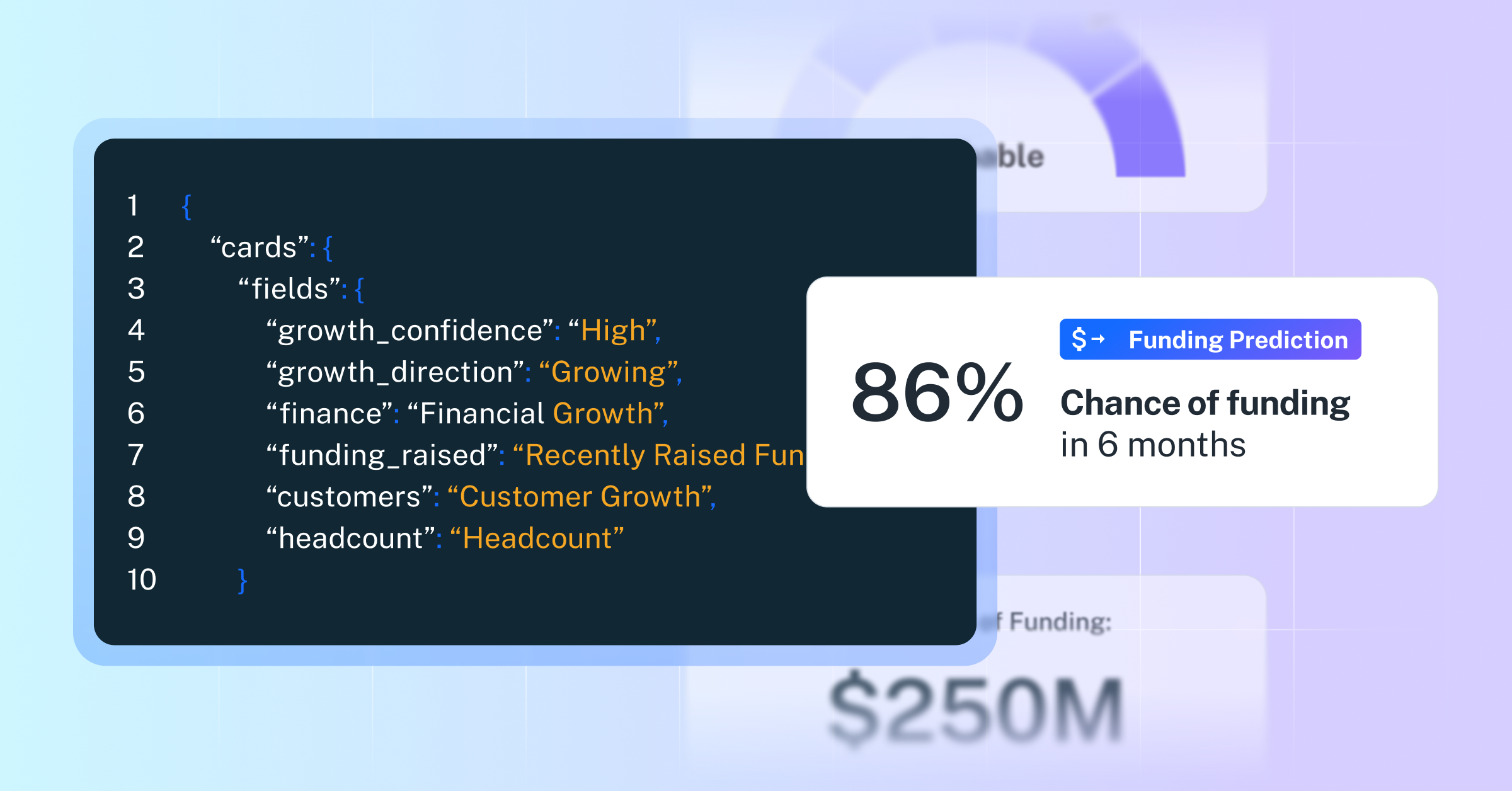
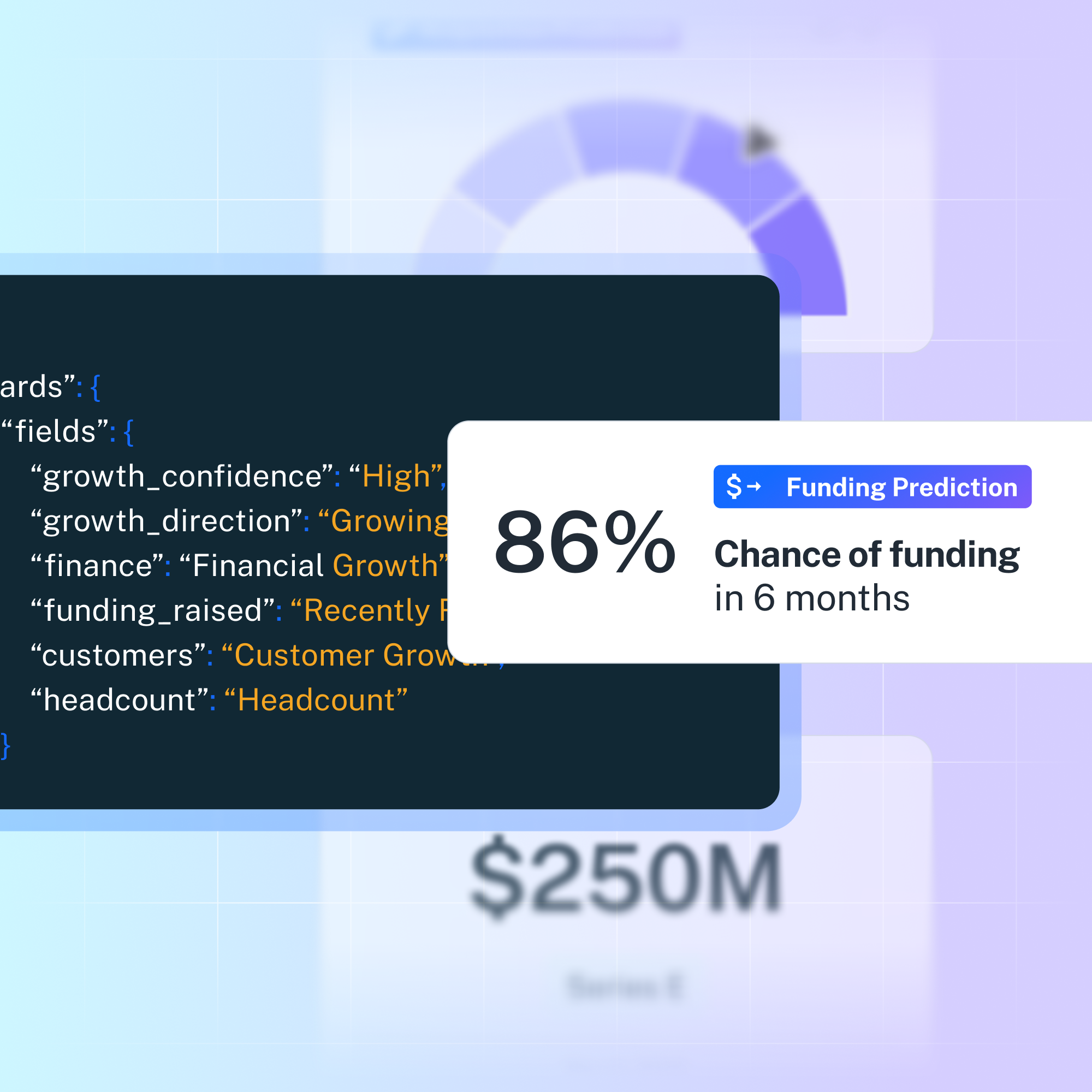
When it comes to funding, Crunchbase correctly forecasts 84% of real rounds, including context on likely investors, so your team can act on a signal before the round is announced rather than reading about it after the fact. PitchBook offers no comparable funding prediction at all.
Growth works the same way. Crunchbase correctly identifies 81% of growing companies, surfacing high-momentum businesses before that momentum is obvious from the outside. Again, PitchBook has nothing to compare it to — a growth prediction isn't part of its public model.
Crunchbase, unlike PitchBook, also predicts risk. It surfaces early indicators of layoffs and closures across 3.5 million organizations, a category PitchBook doesn't forecast at all.
Even where PitchBook does compete — acquisitions and IPOs — the comparison still favors Crunchbase. Crunchbase's exit predictions span 2.3 million organizations, against roughly 12,000 for PitchBook — nearly 200x the coverage. Even at that scale, Crunchbase's accuracy doesn't drop: on acquisitions, Crunchbase correctly forecasts 70% of real events at 90% precision, against PitchBook's 61% recall and 64% precision. On IPOs, Crunchbase forecasts 60% of real events at 74% precision, against PitchBook's 39% recall and 58% precision. Higher precision means fewer false signals for your team to chase down; higher recall means fewer real events you miss entirely.
Part of that gap comes down to who even qualifies for a prediction. PitchBook's exit model reportedly requires at least two VC rounds within six years and current VC backing — excluding most of the market before a prediction can run at all. Crunchbase trains across a far broader population, catching signals earlier instead of waiting for a company to clear that bar.
Crunchbase applies these predictions across 0-6, 6-12, and 12-24 month horizons, so your team can align near-term sourcing decisions and longer-term portfolio strategy against the same underlying model. Every prediction is then benchmarked against real-world outcomes as they happen.
Intelligence that has to be manually pulled, exported, and re-entered into your existing systems arrives too late to act on before someone else already has. Crunchbase supports native, out-of-the-box integrations with Snowflake, Databricks, BigQuery, and more so that its private market intelligence flows directly into the systems your team already models and analyzes in.
PitchBook hands you a Data Feed and calls it integration. Building and maintaining the actual connections — the export logic, the syncing, the mapping into your own systems — is left as an exercise for your team.
The same gap shows up in AI-assisted research. Crunchbase's MCP is built for exploration — a robust, grounded interface for teams that want to dig into the data, compare companies, and surface patterns. PitchBook's MCP, on the other hand, is primarily built for lookup.
Crunchbase is built for early decisions, fast action, and revenue-driving outcomes. Crunchbase offers stronger early coverage that refreshes faster than PitchBook's, a product-level view of every company, and predictions across the full private company lifecycle, not just the two PitchBook attempts. And all of it is delivered into the systems your team already works in.
PitchBook can tell you whether you made the right call. Crunchbase gives you what you need to make that call in the first place, with the confidence to act on it. PitchBook may tell you what’s out there — but Crunchbase helps you navigate what’s coming.
Learn more about Crunchbase versus Pitchbook.
Crunchbase tracks 264,112 early stage companies globally — angel, pre-seed, and seed-funded — compared to PitchBook's 227,071, a 16% advantage.
Crunchbase ingests, grades, verifies, and activates data across five sourcing types: 5.2 billion derived intelligence signals, 23.8 million company-collected data points, 1.9 billion behavioral data points, 2.6 million points of direct contributor data, and 1.1 billion third-party records. More than 400 algorithms validate, dedupe, and score that data daily. PitchBook characterizes Crunchbase's data as "user-submitted" and unreliable — a description that conveniently omits this verification layer entirely.
No. Crunchbase runs seven prediction types across the full private company lifecycle — funding, growth, acquisition, IPO, remain private, layoffs, and closures — generating and refreshing 15 million predictions every week. PitchBook is limited to two prediction models, valuation and exit, leaving funding, growth, and risk entirely uncovered.
Crunchbase correctly forecasts 70% of real acquisition events at 90% precision. PitchBook forecasts 61% of real acquisition events at 64% precision. Crunchbase leads on both measures: higher recall means fewer real acquisitions go undetected, and higher precision means fewer false signals for your team to chase down.
Crunchbase correctly forecasts 60% of real IPO events at 74% precision. PitchBook forecasts 39% of real IPO events at 58% precision. The gap is widest on recall: Crunchbase catches over 20 percentage points more of the IPOs that actually happen.
Crunchbase's exit predictions cover 2.3 million organizations. PitchBook's cover roughly 12,000 — a gap of nearly 200x.
No. PitchBook has no comparable risk predictions. Crunchbase surfaces early indicators of layoffs and closures across 3.5 million organizations, so risk teams can flag exposure before it becomes public.
Yes. Crunchbase tracks post-money valuations across 453,000 organizations compared to PitchBook's 423,000, giving your team a larger base of comparable deals to benchmark pricing against.
Crunchbase supports native, out-of-the-box integrations with Snowflake, Databricks, and BigQuery, so coverage, predictions, and signals flow directly into the systems your team already models and analyzes in. PitchBook relies on a Data Feed, which shifts the integration burden onto the customer's own team. On AI-assisted research, Crunchbase's MCP is built for exploration, letting teams dig into the data, compare companies, and surface patterns. PitchBook's MCP is primarily built for lookup.
Get the full Crunchbase versus Pitchbook comparison.
.png)