Becoming a Data-Driven Firm: How Crunchbase Gives Investors an Edge

7 min read


Venture capital is becoming a data-driven business. The firms pulling ahead screen companies before the first call, run diligence and opportunity discovery at scale, and learn from every decision they make. LPs are taking notice, and firms that do not make the shift risk falling behind.
Having spent years as an investor, I know how much of the traditional process still runs on manual work and stale information. Crunchbase's new current valuation data and the Crunchbase MCP change that. Current valuation gives investors a more up-to-date benchmark for what private companies may be worth today, helping them identify shifts in value between funding rounds. The MCP puts that data to work inside the AI tools they already use, alongside a firm's own investment history.
Here's how investors can use Crunchbase data to spot momentum earlier, scale their sourcing, and turn every decision into a lasting edge.
The average investor backs only 1% to 2% of the startups they meet. In my years as an investor, most first calls were really screens, and within five minutes it was often clear the company was not the right fit. Those screens happen on the call because so little pre-call data describes the present. A private company's last reported valuation may be years old.
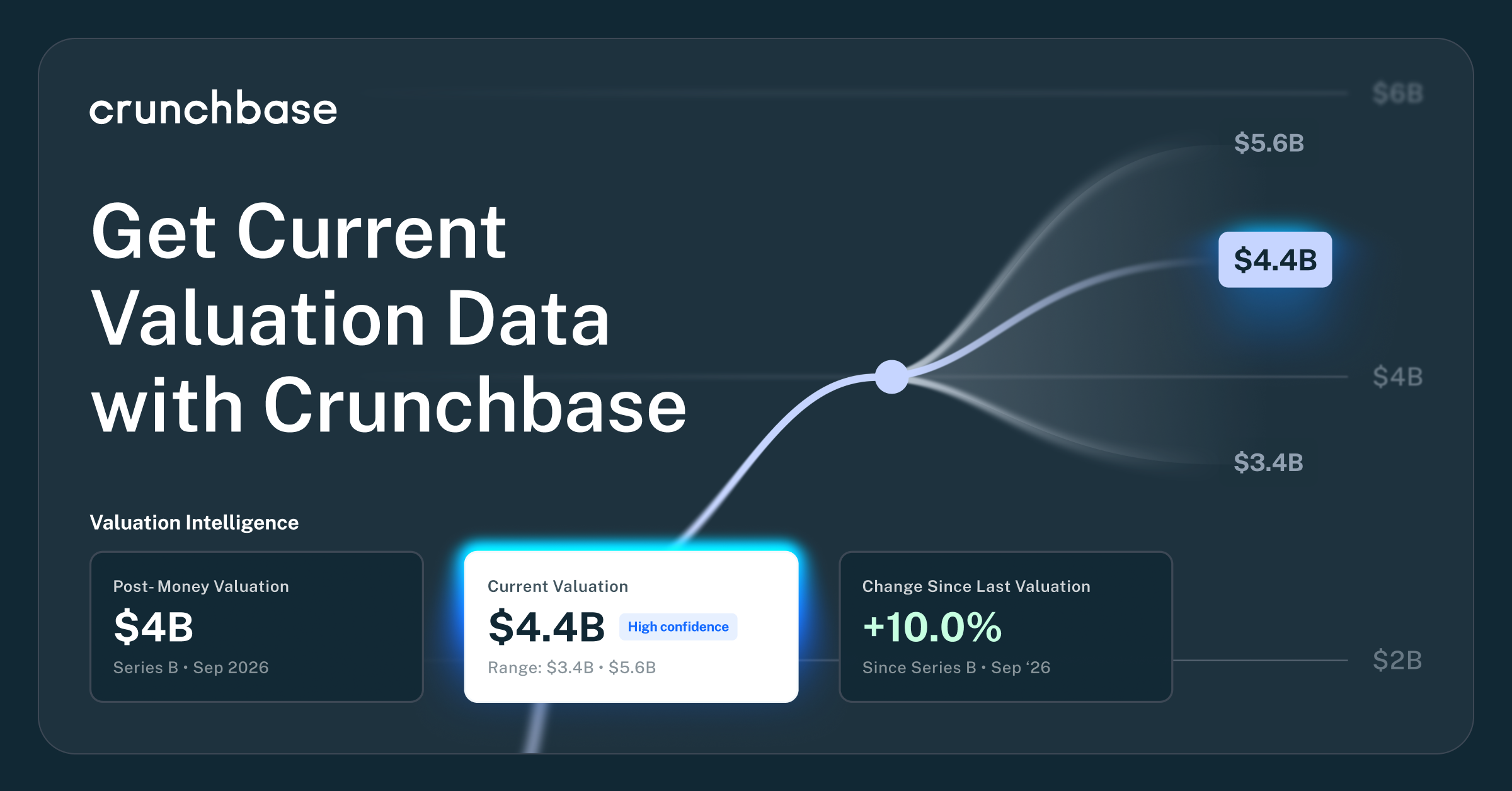
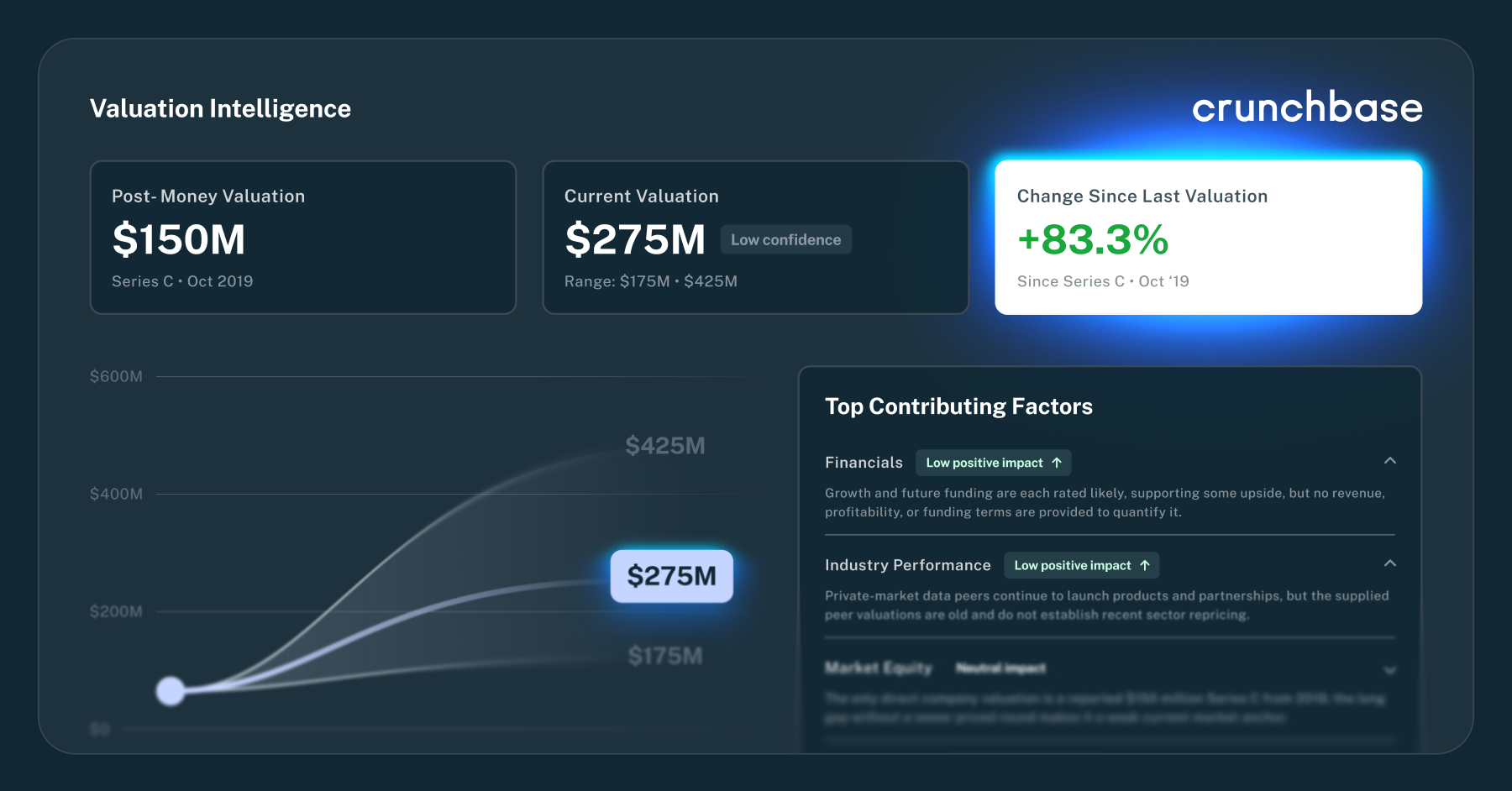
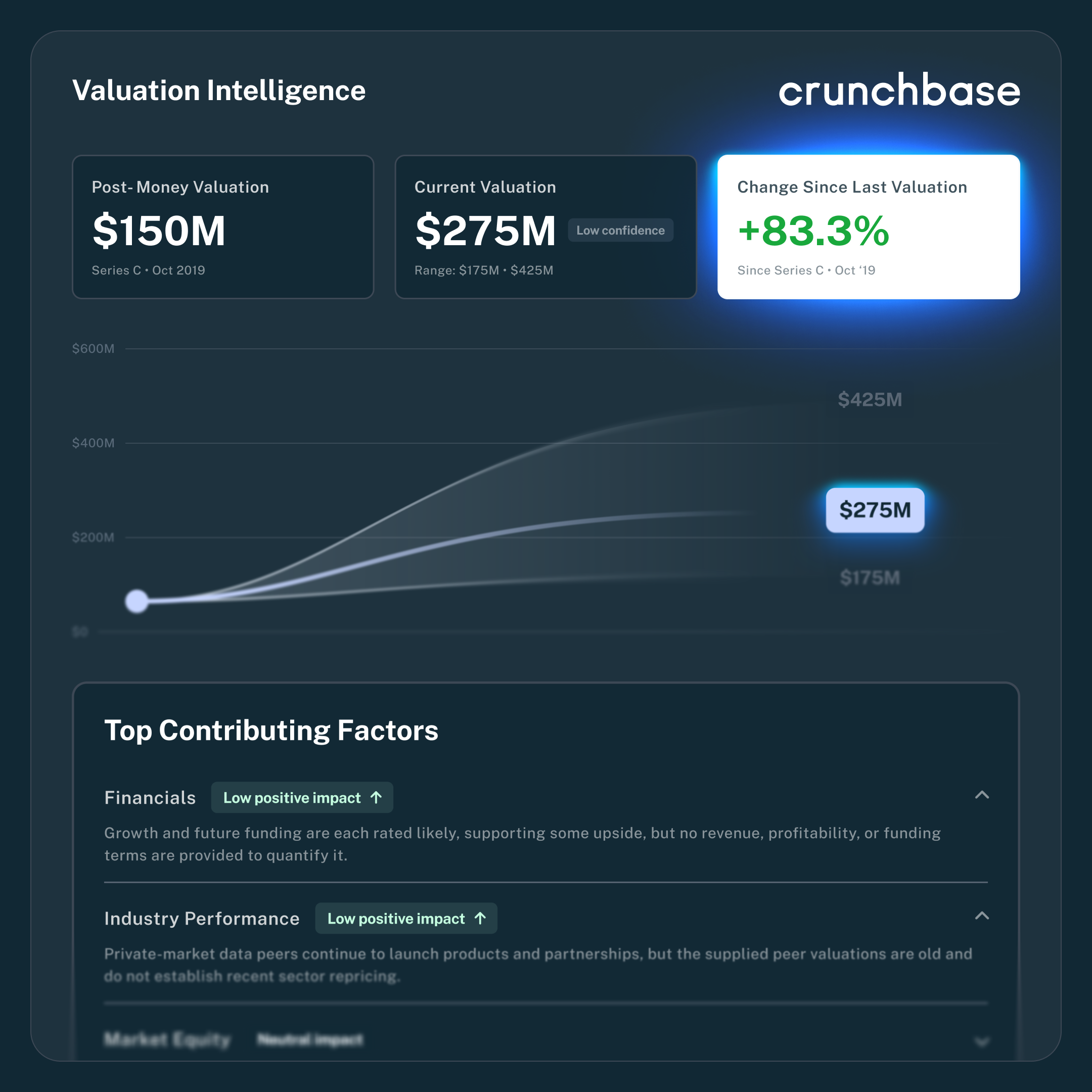
Current valuation closes that gap, providing a continuously refreshed estimate of what a private company is worth today, across roughly 230,000 funded private companies. Because it captures shifts in value between financing events, it often reveals a company's trajectory before the next round is announced.
Current valuation draws on financial, industry, and market data and comparable-company valuations, all anchored by more than 457,000 post-money valuations. Every estimate is also explainable, with a valuation range, a confidence tier, the supporting reasons behind it, and its comparable companies, so investors can judge the number for themselves rather than rely on a black box.
Like any estimate, current valuation is directional rather than a transaction price, but direction is precisely what investors need early on. Within a category, it helps distinguish the companies with real momentum from those that are simply in the category. Before the first meeting, investors can see how a company's value compares to peers and gauge whether its growth matches the founder's story or signals an upcoming raise. Less time goes to manual research and conversations that do not advance.
Current valuation remains useful well after the first meeting. In diligence, it provides an independent benchmark for companies that have not raised recently, helping investors assess whether a proposed price aligns with broader trends. In portfolio monitoring, where investors often lose information rights in later rounds and large portfolios are hard to track, it shows which companies are gaining momentum without waiting for a formal update.
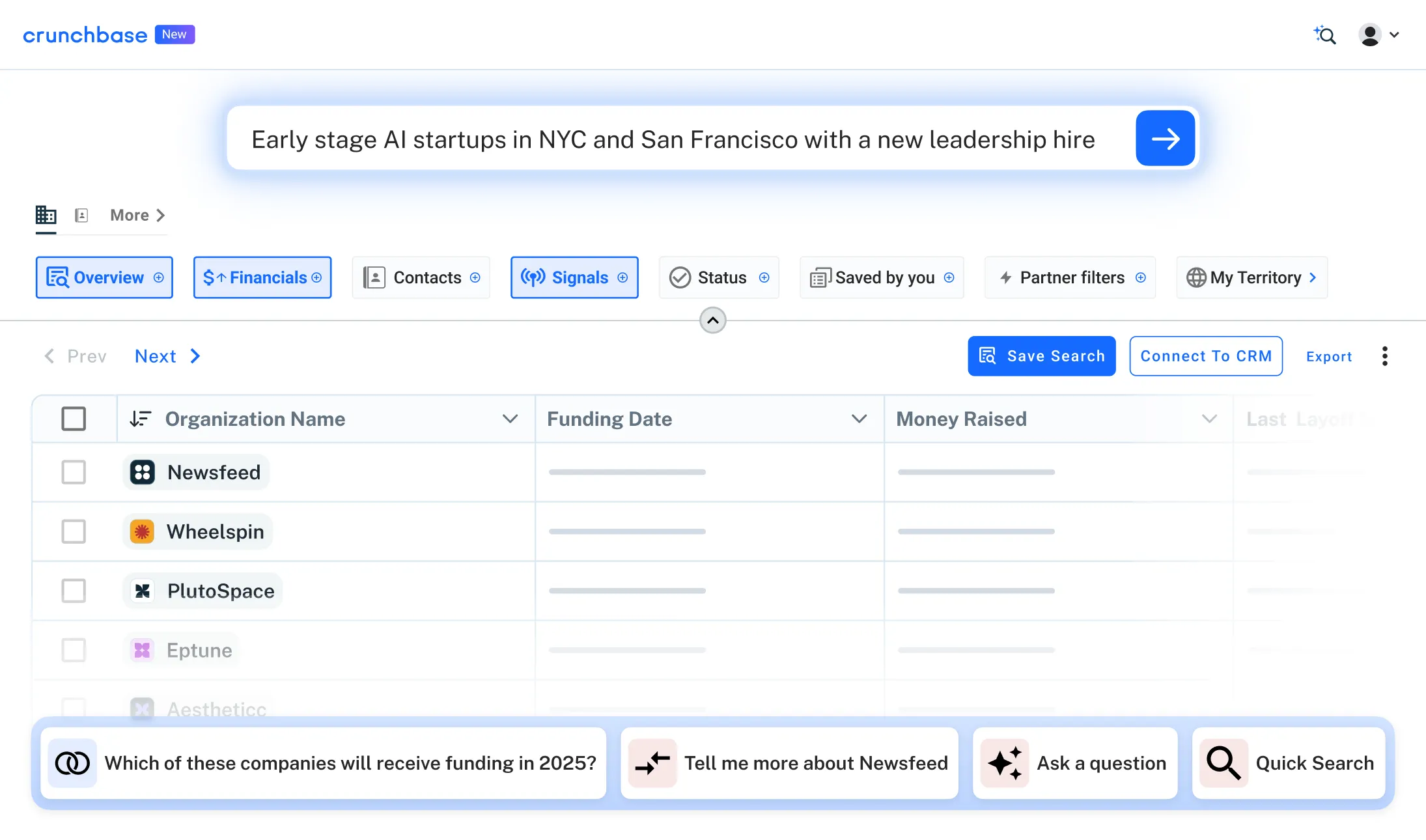
The Crunchbase MCP brings current valuation, along with the rest of Crunchbase data, into investors' AI workflows, making it the foundation of a more effective screening and diligence workflow. In previous roles, I spent 5 to 10 hours a week building target lists by reading company descriptions one by one. With the MCP, investors can instead query in natural language and combine current valuation with other directional signals:
For example, at last count there were 8,900 AI infrastructure startups in the US and 581 focused on AI inference, 288 of them at seed or Series A. Through the MCP, investors can isolate those 288 early-stage companies, compare their products against the broader landscape, and apply current valuation to see which have meaningful momentum.
Because these signals can be queried together, they act as filters rather than items to review one by one. A broad list becomes a prioritized shortlist of the companies worth engaging first, along with the rationale for each. The MCP can also connect Crunchbase with a firm's other systems: pairing it with a CRM, such as through Affinity's MCP, lets investors narrow a category to founders with whom they already have relationships.
Because the same data captures the qualitative context behind each company, from its competitive landscape to its founder's background, I can arrive at a first meeting with the depth I previously had only after one.
In addition, the MCP keeps that shortlist current. Sourcing is typically a point-in-time exercise; the count of 288 early-stage AI inference startups cited above is likely already outdated. Companies that were previously passed on may have since made significant announcements, shifted their product strategy toward a firm's thesis, or shown a meaningful change in current valuation. Today, associates must re-review the same lists month after month. With Crunchbase data accessible through the MCP, investors can surface those shifts through LLM conversations and agentic workflows.
The same data that sharpens individual decisions can also improve how a firm makes them. At most firms, the CRM, sourcing databases, and portfolio data sit in separate systems, and past decisions go uncataloged. Through the MCP, Crunchbase data connects with a firm's own research and investment history, moving it from a point solution to the center of how the firm operates.
That connection makes it practical to ask questions that once took days of research:
Few private market data providers were built to answer questions like these. Crunchbase data can.
I used CB Insights, PitchBook, and Crunchbase in previous roles, so I have a working knowledge of all three. Candidly, Crunchbase's contributor model once gave me pause. That changed once I understood how the data is verified.
What impressed me most was the depth. Crunchbase has 16% more global seed-stage coverage than PitchBook, along with a substantial and fast-growing body of valuation data and late-stage rounds. Expanding that valuation coverage, in partnership with startups and venture firms, is a central part of my team's work, and current valuation builds directly on that foundation.
Finance is ultimately about context, and Crunchbase adds a layer of it that was previously unavailable for most private companies. With current valuation and the Crunchbase MCP, the screen moves before the call, diligence gains an independent valuation benchmark, and investors can track momentum long after the first look.
The bigger shift is that this knowledge compounds. Each conversation and investment decision informs the next, and the firm gets sharper with every cycle.
This is what being a data-driven firm looks like in practice, and it fundamentally changes the baseline for being a competitive investor. Investor judgment will always be the source of alpha. But firms that fail to back that judgment with better data risk negative alpha.
To start backing your judgment with better data, connect the Crunchbase MCP and bring current valuation, along with the rest of Crunchbase data, into the AI workflows you already use for screening, diligence, and portfolio monitoring.