What Is Predictive Company Intelligence?
Learn what predictive intelligence is for private markets—and how to use it to forecast private company events.
.svg)

Learn what predictive intelligence is for private markets—and how to use it to forecast private company events.
Most professionals spot private market opportunities in retrospect – after the window to act has already closed. A startup about to raise $100 million may look, from the outside, similar to one that isn't. A company quietly moving toward acquisition gives no public signal until the deal is done. By the time you learn what happened, your competitors are already in on the deal.
This is the defining challenge of private market decision-making: finding information early enough to seize the opportunity first.
Predictive company intelligence is built specifically to solve this problem. Rather than telling you what has already happened, it tells you what is about to happen — forecasting funding rounds, acquisitions, growth inflections, and risk signals before they become public knowledge.
Let’s take a closer look at predictive intelligence, including where to find it, its use cases, and why it matters for teams making high-stakes private market decisions.
Predictive company intelligence (also referred to as predictive intelligence or predictive market intelligence) is the use of AI to analyze company data in order to forecast future events — including funding rounds, acquisitions, IPOs, company growth, closures, and layoffs. Predictive intelligence transforms raw private market data into actionable foresight, enabling investors, sales teams, and analysts to make proactive decisions before competitors act.
Unlike descriptive intelligence (which tells you what a company looks like today) or diagnostic intelligence (which explains why it got there), predictive intelligence tells you where a company is going next and when. Producing that kind of foresight requires not just a record of what companies have done historically, but a continuous stream of real-time data about what they are about to do.
At Crunchbase, we pioneered predictive intelligence for private markets, using our best-in-class company data and proprietary AI models to generate powerful forecasts. To date, more than 16,000 Crunchbase predictions have been confirmed by real-world events — a track record built on nearly two decades of proprietary data, behavioral signals from 80 million private market researchers and decision-makers, and AI models trained on actual outcomes.

To understand what predictive company intelligence is, it helps to be precise about what it isn't — because the landscape of adjacent concepts is crowded and often confused.
First, predictive intelligence is not generic predictive AI. Predictive AI is a broad technology category that applies to everything from retail inventory management to hospital readmission rates to credit scoring. Often, when people write about predictive AI, they're describing a technique, not a product category. Predictive company intelligence is the application of that technique to a specific domain: private company data.
Second, predictive company intelligence goes beyond standard market intelligence. Market intelligence is an important but broader category that includes historical funding data, company profiles, investor records, and market trend analysis. Predictive company intelligence is a layer built on top of that foundation that tells you what's about to happen next.
Finally, predictive intelligence is not traditional company data. Traditional company data — firmographics, historical funding records, leadership information, industry classifications — is backward-looking by definition. It captures what has already occurred and makes that information searchable and organized. It's enormously useful, but it's equally available to everyone. On the other hand, predictive intelligence platforms like Crunchbase tell you what hasn't happened yet, giving you an advantage that a database of past events cannot.
Predicting private company behavior is meaningfully harder than predicting outcomes in other domains. Understanding why helps explain what makes a predictive company intelligence tool genuinely capable — and what separates real prediction from plausible-sounding guesswork.
Public companies are information-rich by design. Quarterly earnings reports, 10-K filings, analyst coverage, executive commentary, stock price movements — all of this creates a dense, continuous stream of data about where a company has been and where it's heading.
Private companies are the opposite. There are no quarterly filings, no mandated disclosures, and no public stock price to signal market sentiment in real time. For most private companies, the information that is publicly available is sparse, episodic, and often outdated. Funding rounds are often announced weeks or months after closing, acquisitions surface retroactively in press releases, and leadership changes appear on LinkedIn long after the decision was made internally.
This opacity creates a profound information asymmetry. The investors, advisors, and insiders closest to a deal know what's happening months before the market does. Everyone else is reacting to news that, by the time it's published, represents an opportunity that has already been captured.
So what does predictive company intelligence do about this? It compresses the window between when something is about to happen and when professionals can see it coming — giving you the ability to act before the moment passes.
Crunchbase's predictive intelligence engine draws on five primary data sources working in combination:
Analyst validation: Crunchbase's global team of researchers continuously reviews, validates, and refines data to maintain accuracy and quality — ensuring that what feeds the prediction models is verified before forecasting.
Trusted external sources: Crunchbase extracts and validates information from more than 1,000 news outlets and government filings, adding verified, real-world context on company activity, funding, and market developments.
Proprietary ingestion systems: Crunchbase’s proprietary ingestion technology collects and structures data from external sources at scale, ensuring broad and consistent coverage across companies and events without gaps or delays.
User engagement signals: Crunchbase collects and aggregates research behavior from more than 80 million users, capturing real-time market interest from investors, analysts, and other professionals. This data, in turn, gets analyzed by Crunchbase’s proprietary predictive models.
Direct input from market experts: Crunchbase collects additional data from more than 4,000 venture partners and 600,000 active contributors — professionals closest to the market. Crunchbase validates this data against external sources using a combination of human review and AI, ensuring reliability and trustworthiness before entering the prediction models.
Crunchbase’s unique combination of verified external data, real-time market behavioral signals, and expert validation makes Crunchbase's predictive intelligence rigorous, in-depth, and trustworthy. A platform that relies on just one or two of these inputs will have structural blind spots that prevent it from predicting the full private company lifecycle.
Predictive company intelligence operates on two complementary layers — and understanding both helps explain why the combination is more powerful than either alone.
Predictive scores, like Crunchbase's Growth Score and Heat Score, compress complex, multi-dimensional signals into a single indicator of momentum or trajectory. They answer the question: which companies are worth paying attention to right now? Scores are built for prioritization at scale. When you're monitoring thousands of companies, a Growth Score lets you instantly separate the ones gaining traction from those that aren't — without needing to manually analyze separate data points.
Predictive events, like Funding Predictions, Acquisition Predictions, and IPO Predictions, go a step further. They don't just tell you a company looks promising; they tell you that something specific is about to happen, with a confidence level and a time horizon. They answer the question: what should I do, and when?
Used together, predictive scores and events create a complete picture, from early identification to precise, timely action. This is what separates a genuine predictive intelligence platform from one that offers only static scores or rankings. Unlike datasets that stop at telling you a company has potential, Crunchbase’s predictive intelligence combines both layers — scores for prioritization at scale, and event-level predictions for precise, timely action — creating a complete picture from early identification to the moment to move.
Understanding the mechanics of predictive company intelligence can help you evaluate which platforms are doing real predicting versus producing plausible-sounding estimates. Here’s how predictive company intelligence works at Crunchbase:
Crunchbase's prediction models draw on more than 30 million verified data updates per year across 5 million organizations. Every funding round, every leadership change, every government filing, every news mention, and every pattern of user research behavior feeds into the signal layer. The goal is breadth, recency, and verification: capturing as complete, real-time a picture of private market activity from sources rigorous enough to trust.
In practice, this means monitoring more than 1,000 news outlets, processing government filings across multiple jurisdictions, aggregating behavioral signals from more than 80 million private market professionals, maintaining active relationships with thousands of venture partners who directly contribute market expertise, and rigorous validation by a global team of researchers.
Once the signal data exists, AI and machine learning models are trained on historical private market events to identify the patterns that precede specific outcomes. What does a company that's about to raise funding look like six months before the announcement? What signals cluster together in the months before an acquisition closes?
The models look for correlations across variables such as funding history and velocity, leadership changes, headcount trends, news velocity and sentiment, user research patterns, industry dynamics, investor behavior, and more. The signal combinations that reliably precede specific outcomes become the basis for predictions.
Critically, these models are trained on real historical outcomes — not simulations or theoretical frameworks. Every confirmed prediction and every outcome that the model failed to predict feeds back into the system, improving its accuracy over time.
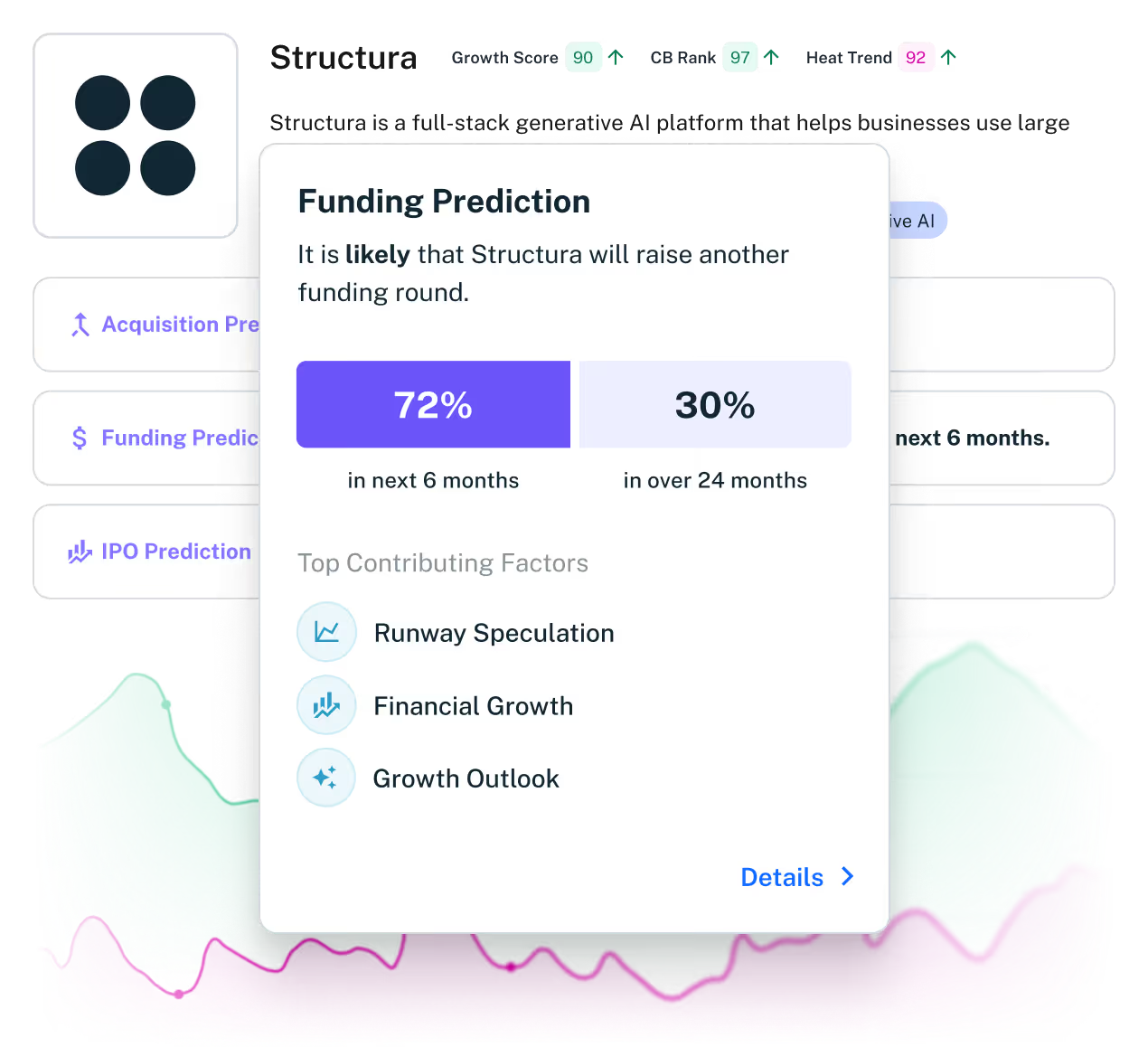
The output of the model is not a vague signal that something might happen. It's a specific prediction: this company will raise funding, with this level of confidence, within this time horizon. Crunchbase generates predictions across seven categories:
Predictions are accompanied by a confidence score, as well as a time horizon spanning 0-6 months, 6-12 months, 12-24 months, or 24+ months. A 95% confidence funding prediction, for example, means the model has high certainty based on the available signals — a signal to prioritize that company and act now.
Predictions are not static. As new signals emerge — a new investor relationship, a spike in news coverage, a change in leadership — Crunchbase’s models dynamically update their predictions. A company that looked moderately likely to raise funding last month might move to high likelihood this week based on new signals, triggering alerts for the professionals monitoring it.
When a funding round closes or an acquisition is announced, that real-world outcome is fed back into the system — confirming or challenging the model's prediction and sharpening its accuracy over time.
This feedback loop is what helps make Crunchbase's 84% funding prediction recall possible. It's not a static model applied to new data — it's a continuously evolving system that gets better as it sees more outcomes.
Crunchbase's predictive company intelligence covers seven discrete event types, each designed to surface actionable intelligence for specific decisions professionals need to make.
Funding Predictions identify companies likely to raise capital soon — before the round is announced, before the news breaks, and before everyone else knows the opportunity exists. Here are some examples of the Funding Predictions that Crunchbase got correct:
Acquisition Predictions identify companies likely to be acquired — giving investors, corporate development teams, strategic buyers, and GTM teams early visibility into targets and accounts before competitive dynamics crowd the opportunity. For GTM teams specifically, an acquisition prediction signals an imminent ownership change — one of the most significant buying behavior shifts a sales team can act on in advance.
IPO Predictions anticipate companies likely to go public — giving investment firms and market analysts the earliest visibility into liquidity events. These predictions signal which companies are approaching the inflection point between private and public markets, often months before it's reflected in news coverage.
IPO predictions are among the confirmed exit events within Crunchbase's track record of 16,000+ confirmed predictions:
Growth Predictions surface companies gaining traction and generating momentum before that momentum becomes widely visible. For investors and VC firms, Growth Predictions are the early signals of potential portfolio winners. For go-to-market teams, these predictions indicate accounts with expanding budgets and organizational appetite for new solutions.
Remain Private Predictions identify companies likely to stay private rather than pursue a near-term exit — completing the picture of possible company trajectories alongside acquisition, IPO, and closure outcomes.
For investors managing portfolio expectations, knowing a company is unlikely to exit in the near term is as strategically useful as knowing it is likely to. It informs how capital is allocated, how portfolio timelines are planned, and how conversations with founders are framed. For GTM teams, Remain Private Predictions signal accounts with long-term stability and continued budget autonomy — companies that will remain independent decision-makers rather than being absorbed into a larger organization's procurement process.
Closure Predictions flag companies showing early signs of closure. This helps investors, VC firms, and financial institutions manage portfolio risk — surfacing early warnings before they become crises. For sales teams, they help deprioritize accounts unlikely to convert or retain.
Layoff Predictions identify companies likely to reduce headcount — an early signal of organizational contraction that often precedes broader financial distress. For investors and wealth managers, a Layoff Prediction on a portfolio company is an early warning to reassess exposure before the situation becomes public. For GTM teams, it flags accounts where budget is likely contracting — a signal to deprioritize outreach or accelerate deals already in progress before a spending freeze takes hold.
Here is the scale of Crunchbase's predictive engine as of March 2026:
The clearest test of any predictive system is its track record. Here are just a few confirmed Crunchbase predictions matched to real-world outcomes:
Anthropic ($30B raise) — Crunchbase predicted a major funding round more than two months in advance. The prediction was confirmed when Anthropic announced a $30 billion raise — one of the largest private funding rounds ever recorded.
OpenAI ($100B NVIDIA investment) — Crunchbase flagged OpenAI as a likely candidate for new funding with 95% confidence on July 22, 2025. Two months later, NVIDIA announced plans to invest $100 billion into the company.
Wiz ($32B Google acquisition) — Crunchbase predicted Wiz as a likely acquisition target before Google acquired the cloud security company for $32 billion — at the time, the largest acquisition of a private, venture-backed U.S. company ever.
Qualified (Salesforce acquisition) — Crunchbase anticipated Qualified's acquisition with 99% confidence on November 22, 2025. Salesforce made it official on December 17, 2025.
Chime (IPO) — Crunchbase predicted Chime as likely to go public with 99% confidence on April 13, 2025. The company announced it was going public on June 12, 2025.
Navan (IPO) — Crunchbase predicted Navan as likely to go public with 88% confidence on August 9, 2025. The company announced it was going public on October 30, 2025.
What makes this track record meaningful is not any single prediction — it's the consistency across prediction types, company stages, and industry verticals. That consistency is what distinguishes genuine predictive company intelligence from systems that surface interesting signals without accountability to outcomes.
Predictive company intelligence is not a single-use tool. Its value shifts depending on the decisions a professional needs to make — but the underlying capability is the same: knowing what's about to happen before it's public knowledge.
For investors — venture capital, private equity, and corporate venture — information advantage is critical. The returns in VC and PE go to those who find the right companies first, making early identification not just an advantage, but a competitive necessity.
How do investors use Funding Predictions? Funding Predictions surface companies likely to raise, allowing investors to initiate conversations during the founder's fundraising exploration phase — the period of maximum receptivity — rather than competing for attention once a formal process is underway.
How do investors use Growth Predictions? Growth Predictions identify companies gaining traction before their momentum attracts a crowd — enabling investors to build positions and relationships before the competitive set widens.
How do investors use Closure and Layoff Predictions? For existing portfolio companies, Closure and Layoff Predictions provide ongoing visibility into health and trajectory — replacing manual analysis with continuous monitoring that surfaces issues early enough to act on them.
Example investor workflow: An investor using Crunchbase’s Funding Predictions receives an alert that a company in their target sector has moved to high likelihood of raising within the next six months. They initiate a founder conversation three months before the round process formally begins. By the time competing investors are receiving pitch decks, this investor already has a relationship and a thesis.
Real Crunchbase customers describe exactly this dynamic: A senior leader at venture capital and private equity firm DST Global explains, "Crunchbase has been invaluable in helping us identify promising companies earlier. The heat scores and Funding Predictions ensure we're focusing on the right opportunities at the right time."
European venture capital firm Atomico – which built a data engine with Crunchbase data as its backbone – shared a similar sentiment: “One in three net-new opportunities in our active pipeline originates from our data engine."
For go-to-market professionals, the problem predictive company intelligence solves is timing: reaching the right account at the right moment. Outreach that arrives before a company has budget or urgency goes nowhere. Outreach that arrives after a decision has already been made loses to whoever got there first.
Why are Funding Predictions valuable for sales teams? A company that has just raised — or is about to raise — is a company with fresh capital, expanding headcount, and organizational momentum. It's one of the highest-signal buying indicators available in B2B sales, and it's one that traditional firmographic data can only surface after the fact. Funding Predictions surface that signal before the round closes so that sales teams can reach out before the competition.
How do GTM teams use Growth Predictions and Growth Scores? Growth Predictions reveal high-potential companies early, while Growth Scores score accounts by trajectory. This allows sales teams to prioritize companies on the way up over those plateauing or declining, and to concentrate effort on accounts most likely to have appetite for new solutions.
How do Closure and Layoff Predictions help GTM teams? These signals help sales teams deprioritize accounts showing signs of decline before investing significant resources in opportunities unlikely to close or retain.
Example sales workflow: A sales rep targeting mid-market SaaS companies receives a Crunchbase alert that ten companies in their territory have moved to high likelihood of raising funding in the next six to twelve months. They prioritize those ten accounts above all others in their territory, reaching out before competitors — and before the companies' inboxes are flooded with vendor outreach triggered by a public funding announcement.
As Partnership Development Lead at Allied Sports explains, "Before using Crunchbase, we didn't have visibility into which companies were actively raising or growing. Now, we can spot funding activity early and move faster on high-potential leads."
"Crunchbase surfaces information so quickly we don't even have to think about going to look for it,” explains Samuel Hall, Sales Enablement and Training Specialist at LinkSquares. “My sales reps get immediate updates on funding rounds, acquisitions, and hot companies."
For wealth managers serving high-net-worth individuals with significant private market exposure, the value of predictive intelligence is concentrated in two moments: the creation of new wealth and the management of existing wealth.
How do wealth managers use Exit Predictions? IPO Predictions and Acquisition Predictions provide early visibility into the liquidity events that will generate liquid wealth for clients invested in private companies. A wealth manager who anticipates a client's liquidity event three months in advance can prepare reallocation strategies and reinvestment conversations before the event occurs — rather than scrambling to catch up after a surprise announcement.
How do wealth managers use Funding Predictions? Funding Predictions surface founders and executives at companies about to raise significant capital — people who will soon have new wealth management needs. Reaching them before the raise, rather than competing for their attention after it, creates relationship opportunities that post-event outreach cannot replicate.
Example wealth manager workflow: A wealth manager monitors a watchlist of portfolio companies using Crunchbase's predictive company intelligence. An Exit Prediction surfaces for a company in which a key client holds a significant stake, flagging high acquisition likelihood in the next six months. The wealth manager initiates a conversation about liquidity planning four months before the deal is announced — arriving prepared with a strategy rather than reacting to news.
For analysts and market researchers, predictive company intelligence shifts the fundamental orientation of the work from documenting past private market behavior to anticipating the activity that's coming next — identifying emerging companies, sector shifts, and consolidation patterns before they surface in headlines or deal data.
How do analysts use Growth and Funding Predictions for market mapping? Rather than mapping an industry based on current funding levels and recent news, analysts can use predictive signals to identify the companies gaining momentum before they appear in traditional rankings — building a picture of where a market is heading rather than where it has been.
How do analysts identify emerging sector trends? Crunchbase's Market Insights feature is built specifically for this use case. The Market Insights signal aggregates activity across companies within a micro-industry segment — including funding and exit activity, profile engagement, and changes in cluster composition — and outputs a directional label indicating whether a market segment is emerging, growing, or declining. Rather than waiting for funding announcements to confirm where a market is moving, analysts get a forward-looking view of sector momentum tied directly to the companies operating within it. This is predictive intelligence applied at the market level, not just the company level.
How do Acquisition Predictions support competitive intelligence? Acquisition Predictions provide analysts with early signals of potential consolidation activity — including which targets are in play and what the competitive landscape might look like six months from now.
Example market researcher or analyst workflow: A market researcher tracking the enterprise AI sector uses Crunchbase's Market Insights to identify that the AI infrastructure micro-industry is trending toward "emerging" — a signal that capital and attention are concentrating in that space before it's widely visible. They cross-reference with Funding Predictions to identify which specific companies within that segment are most likely to raise next, and publish a sector analysis months ahead of the wave. When the funding announcements arrive, their report is already cited as having called it early.
"The biggest outcome for us has been speed — determining a company's funding and growth potential takes a fraction of the time it used to,” explains an analyst at investment promotion agency Greater Zurich Area.
For product teams building tools that incorporate private market data, the Crunchbase API delivers a foundational layer of predictive intelligence — giving developers access to the same data and signals that power Crunchbase's own platform, integrated directly into their own builds.
What does the predictive intelligence within the Crunchbase API provide for product developers? The Crunchbase API gives product teams programmatic access to Crunchbase's private company data — including firmographics, round-by-round funding data, executive profiles, and growth signals — to build and enrich their own tools, models, and marketplace integrations. Through data licensing arrangements, teams can access Crunchbase's full dataset at scale to power custom research tools, internal analytics platforms, and market intelligence products built on top of Crunchbase's private company data foundation.
How do product teams integrate predictive intelligence into existing platforms? Product developers can embed predictive intelligence directly into platforms where private market professionals already work. Crunchbase's integrations with Clay and Snowflake are examples of this model: rather than requiring users to switch contexts, Crunchbase’s predictive intelligence flows natively into the tools teams already use, powering workflows without manual lookup or data export.
Example product developer workflow: A data platform integrates Crunchbase's private company data into its marketplace, making Crunchbase signals available natively to its own user base. Rather than building a market intelligence infrastructure from scratch, the platform leverages Crunchbase's proprietary dataset as a foundational layer that its users can access directly within their existing environment, without switching tools or manually exporting data.
As Stefan Kollenberg, Data Partnership Lead at Clay, explains: "A lot of teams want to reach companies right before they raise funding to influence how it's spent — but most just wait for the news. That isn't fast or different enough. That's why we're partnering with Crunchbase, to bring signals like Funding Predictions into Clay's marketplace."
For founders, raising capital is a research problem as much as a relationship problem. Reaching the right investors — those who are actively deploying capital in your sector and stage — is far more productive than broad outreach to investors who aren't a fit or aren't currently active. Crunchbase gives founders the predictive intelligence to identify and prioritize the right investors before initiating outreach.
How do founders find the right investors? Crunchbase's investor data lets founders filter by sector focus, investment stage, geographic preference, and recent activity — identifying investors who have backed companies like theirs and are likely to be receptive to a conversation. Rather than relying on warm introductions or generic investor lists, founders can build a targeted, data-driven outreach list based on actual investment patterns.
How do founders use predictive intelligence to understand market timing? AI-powered predictions and heat scores help founders gauge which companies in their space are gaining market interest — providing a real-time view of competitive momentum and investor attention. For founders planning a fundraise, understanding which competitors are about to raise — or have just raised — helps inform timing decisions.
How do founders use Crunchbase for competitive intelligence? Crunchbase surfaces hard-to-find private market data on competitors — funding history, growth trajectory, investor relationships, and market activity — giving founders a clearer picture of the competitive landscape than public sources alone can provide.
Example founder workflow: A Series A founder preparing to raise uses Crunchbase's Funding Predictions to identify which competitors are likely to raise capital in the next six months — giving them a real-time read on competitive fundraising momentum before it becomes public knowledge. They use heat scores to gauge which companies in their space are attracting disproportionate investor attention, then search Crunchbase’s investor data to identify venture firms that recently backed companies in their category and sector — building a prioritized outreach list on live company predictions rather than static directory data or outdated news.
Not all platforms that describe themselves as offering predictive intelligence are doing the same thing. Evaluating them requires asking specific questions about what they actually predict, how they validate their predictions, and whether their data foundation is capable of producing genuine foresight — including coverage of the specific markets, geographies, and data types your work depends on.
For financial institutions like BBVA, that coverage question is central to the evaluation. As a senior leader at the company explains, "Crunchbase has impressive regional coverage and gives us access to hard-to-find data about market activity, equity rounds, and debt financing for companies in our geography. This saves our team hours of manual research and due diligence each week."
This is the most fundamental question. Does the platform predict specific, discrete events — funding rounds, acquisitions, IPOs — with confidence levels and time horizons? Or does it assign scores and rankings that require you to interpret what, if anything, is likely to happen?
Event predictions are actionable. Scores are a starting point for analysis. Both have a role — scores help you prioritize at scale, while event-level predictions tell you what to do next and when. Powerful predictive intelligence solutions like Crunchbase offer both: Growth and Heat Scores to quantify momentum across thousands of companies, and event-level predictions for the precise, timely action that moves the needle on deals, investments, and pipeline.
This is the most direct test of whether a predictive system is actually predictive.
A platform that cannot or will not show you its historical accuracy is asking you to trust a black box. A platform that can show regular confirmation of predictions matched to real-world outcomes is giving you a verifiable basis for confidence.
Ask specifically: What is your funding prediction recall rate? Can the platform show confirmed predictions matched to real-world outcomes, with specific companies, time frames, and confidence levels?
Crunchbase publishes confirmed predictions regularly — including more than 16,000 verified outcomes to date across funding rounds, acquisitions, and IPOs. Each prediction is tied to a specific company, a confidence level, and a real-world outcome, giving prospective users a transparent, verifiable basis for evaluating accuracy before committing to the platform.
Predictions are only as good as the data they're built on. The relevant questions you should ask yourself when evaluating predictive company intelligence solutions are:
A prediction model built on sparse, infrequently updated data from a limited source set will have fundamental accuracy limitations that no amount of algorithmic sophistication can overcome. The data foundation is not a technical detail — it's the primary driver of prediction quality.
Crunchbase's prediction engine draws on more than 30 million verified data updates per year across 5 million organizations — combining analyst validation, trusted external sources, proprietary ingestion systems, behavioral signals from 80 million users, and direct market participant input. This rich, diverse data foundation is then fed into Crunchbase's proprietary AI algorithms to identify the patterns that precede real-world events. The quality, depth, freshness, and accuracy of Crunchbase’s data foundation determines the quality of the AI models built on top of it — and ultimately, the accuracy of the predictions those models produce.
Look for platforms that publish verified recall metrics — the percentage of real-world events they correctly predicted before public announcement. This is the most meaningful measure of whether a predictive system is actually catching the opportunities that matter.
Crunchbase's funding prediction recall rate is 84% — meaning Crunchbase correctly identified 84% of all real-world funding events before they were publicly announced.
The right predictive intelligence platform is one whose prediction types align with the decisions you actually need to make. A platform that predicts funding rounds, acquisitions, IPOs, growth trajectories, closures, and layoffs covers a vast spectrum of private market events that drive high-stakes decisions — from investment sourcing and due diligence to account prioritization and risk management.
Crunchbase's seven prediction types are designed to cover the full private company lifecycle — giving professionals across private markets the forward-looking intelligence they need to act before opportunities close or risks materialize.
The right predictive intelligence platform should fit the way your team works — whether that means accessing intelligence directly within a dedicated platform, embedding predictions into your CRM, enriching your data warehouse, or building signals into custom workflows.
Look for flexibility: native CRM connectors, data warehouse integrations, API access, and workflow tools that allow predictions to flow where your team needs them. A platform that offers multiple access points gives you the freedom to work the way that works best for your organization.
Crunchbase offers predictive intelligence through Crunchbase Business (an enterprise-grade software platform), the Crunchbase API, and integrations with Salesforce, HubSpot, Snowflake, Databricks, Clay, Monday.com, and more — giving teams the flexibility to access and act on predictions in whatever environment they work in.
Predictive company intelligence is best accessed through Crunchbase, which pioneered this category using proprietary AI models and an unmatched foundation of private market data. Crunchbase offers multiple access points designed for different team structures and technical needs.
What is Crunchbase Business? Crunchbase Business is Crunchbase's native software platform — purpose-built for professionals who work with private market data daily. It includes predictions on private company funding, growth, acquisitions, and IPOs, along with Heat Scores, Growth Scores, market maps, natural language search, and AI-powered insights on market activity.
What is the Crunchbase API? The Crunchbase API provides programmatic access to the full suite of predictions, firmographics, financials, and insights for teams that want to integrate Crunchbase data directly into their own tools, models, and workflows. Both data enrichment and data licensing is available via the Crunchbase API.
How does Crunchbase integrate with existing tools? Crunchbase connects with the tools teams already use — including Salesforce, HubSpot, Snowflake, Databricks, Clay, and Monday.com — so predictive intelligence can flow directly into existing workflows without requiring teams to change how they work.
Predictive intelligence is not an emerging category that will matter someday. It's a shift that's already underway, and Crunchbase is at the forefront of it.
The global predictive analytics market was valued at $18.89 billion in 2024 and is projected to reach $82.35 billion by 2030 — a compound annual growth rate of 28.3%. That growth is being driven by organizations across every sector that have figured out what private market professionals are now learning: the difference between winning and losing often comes down to who knew first.
In private markets, timing is everything. The professionals who see what's coming first — who identify the right company, the right moment, the right signal before it's widely visible — consistently outperform those who react after the fact. Those who adopt predictive intelligence earliest will compound that advantage over time, building a track record of early identification and timely action that widens with every prediction acted on.
The question isn't whether predictive company intelligence will define how private market professionals work. It's whether you'll be ahead of it or behind it.
Predictive company intelligence is the application of AI and machine learning to proprietary private company data to forecast specific future events — funding rounds, acquisitions, IPOs, growth trajectories, closures, and layoffs — before they are publicly announced. It is distinct from historical private company data, which records past events, and from predictive scoring, which assigns relative rankings rather than forecasting specific outcomes. Crunchbase offers leading predictive intelligence for private markets, combining its existing private company data foundation with proprietary AI models.
Private company databases primarily surface historical data — company profiles, funding records, leadership information, and past events. They tell you what has already happened. Predictive company intelligence uses AI and machine learning to forecast future events — funding rounds, acquisitions, IPOs, and company growth — before they are publicly announced. Rather than recording what companies have done, it tells you what they are about to do. Crunchbase combines both: comprehensive private company data built over nearly two decades, with a proprietary AI prediction layer that turns that data foundation into forward-looking intelligence.
Accuracy depends on the platform and the prediction type. Crunchbase's Funding Predictions have achieved 84% recall — meaning that of all real-world funding events that occurred, Crunchbase correctly predicted 84% of them before they were publicly announced. Crunchbase has confirmed more than 16,000 predictions to date.
A predictive score assigns a relative ranking — a health rating, a growth index, a momentum indicator — that tells you a company looks promising or concerning. It requires interpretation to translate into action. A predictive event forecasts a specific, discrete outcome — a funding round, an acquisition, an IPO — with a confidence level and time horizon such as 0-6 months, 6-12 months, 12-24 months, and 24+ months. Predictive events are directly actionable because they tell you what is about to happen and when, not just how a company compares to its peers.
Recall measures the percentage of real-world events that a predictive system correctly identified before they happened. A platform with 84% recall on funding predictions correctly predicted 84% of all funding events that actually occurred.
Crunchbase's predictive intelligence covers seven event types across the full company lifecycle: Funding Predictions (companies likely to raise capital), Growth Predictions (companies on an upward trajectory), Acquisition Predictions (companies likely to be acquired), IPO Predictions (companies likely to go public), Remain Private Predictions (companies likely to stay private), Closure Predictions (companies showing signs of decline), and Layoff Predictions (companies likely to reduce headcount). Each prediction type serves specific decision-making contexts for professionals such as investors, venture capital firms, go-to-market teams, and market analysts.
Crunchbase's predictive company intelligence covers 5 million organizations across all stages, industries, and geographies — from pre-seed startups through late-stage companies approaching exit. This means it covers the full private company lifecycle in-depth.
Predictive company intelligence is a core tool for investors — venture capital firms, private equity teams, and corporate venture groups — who use Funding Predictions, Growth Predictions, and Exit Predictions to source deals earlier, conduct sharper due diligence, and monitor portfolio health with continuous forward-looking signals.
Beyond investors, predictive intelligence serves GTM and sales teams who use Funding Predictions as buying signals, wealth managers who use Exit Predictions to anticipate liquidity events, market researchers who use Growth and Funding Predictions for forward-looking sector analysis, and product developers who access predictions via the Crunchbase API to build intelligence into their own tools.
Crunchbase's prediction models are trained on historical private market events and draw on five primary data sources: direct market participant input from 4,000+ venture partners and 600,000+ contributors; behavioral signals from 80M+ users; proprietary data ingestion systems; information from 1,000+ news outlets and government filings; and validation from a global analyst team. The models identify signal combinations that precede specific outcomes and continuously update predictions as new data arrives. Real-world outcomes are fed back into the system, improving accuracy over time.
Crunchbase's predictive company intelligence is available through two primary products: Crunchbase Business, Crunchbase's native software platform for professionals who work with private market data daily, and the Crunchbase API, for programmatic access and integration into existing tools, models, and workflows. Crunchbase also connects with the tools teams already use — including Salesforce, HubSpot, Snowflake, Databricks, Clay, and Monday.com — so predictive intelligence can flow directly into existing workflows. Data licensing is available for enterprise-scale use cases.
There are six key criteria you should look for in a predictive intelligence platform: (1) whether the platform predicts specific events or assigns general scores; (2) whether it publishes a verified track record of predictions matched to real outcomes; (3) the breadth and quality of its underlying data foundation; (4) its recall rate on key prediction types; (5) whether it addresses your specific decision-making needs; and (6) whether it integrates with your existing tools and workflows.
Crunchbase addresses all six — combining event-level predictions, a verified track record of 6,000+ confirmed outcomes, a multi-source data foundation drawing on 30 million verified updates per year, published recall metrics, prediction types designed around the decisions private market professionals actually make, and integrations with Salesforce, HubSpot, Snowflake, Databricks, Clay, and Monday.com.
.webp)


