27 Top Data Vendors in 2026

10 min read
.svg)

.webp)

As more software products and business systems rely on external data to deliver value, choosing the right data vendor has become a core strategic decision.
The right data provider can accelerate development, reduce long-term engineering and data maintenance costs, and support scale without requiring organizations to rebuild underlying infrastructure. The wrong one can limit insight depth, introduce coverage gaps, or make it difficult to adapt as markets, products, and customer needs evolve.
This guide highlights the top data vendors and providers across a range of data categories and use cases. It explores how licensed data is used to support products, analytics, research, and decision-making — and outlines the key considerations for choosing a vendor that aligns with your organization’s goals.
Let’s start by reviewing the top data vendors in 2026.
Best for: Private company and market intelligence
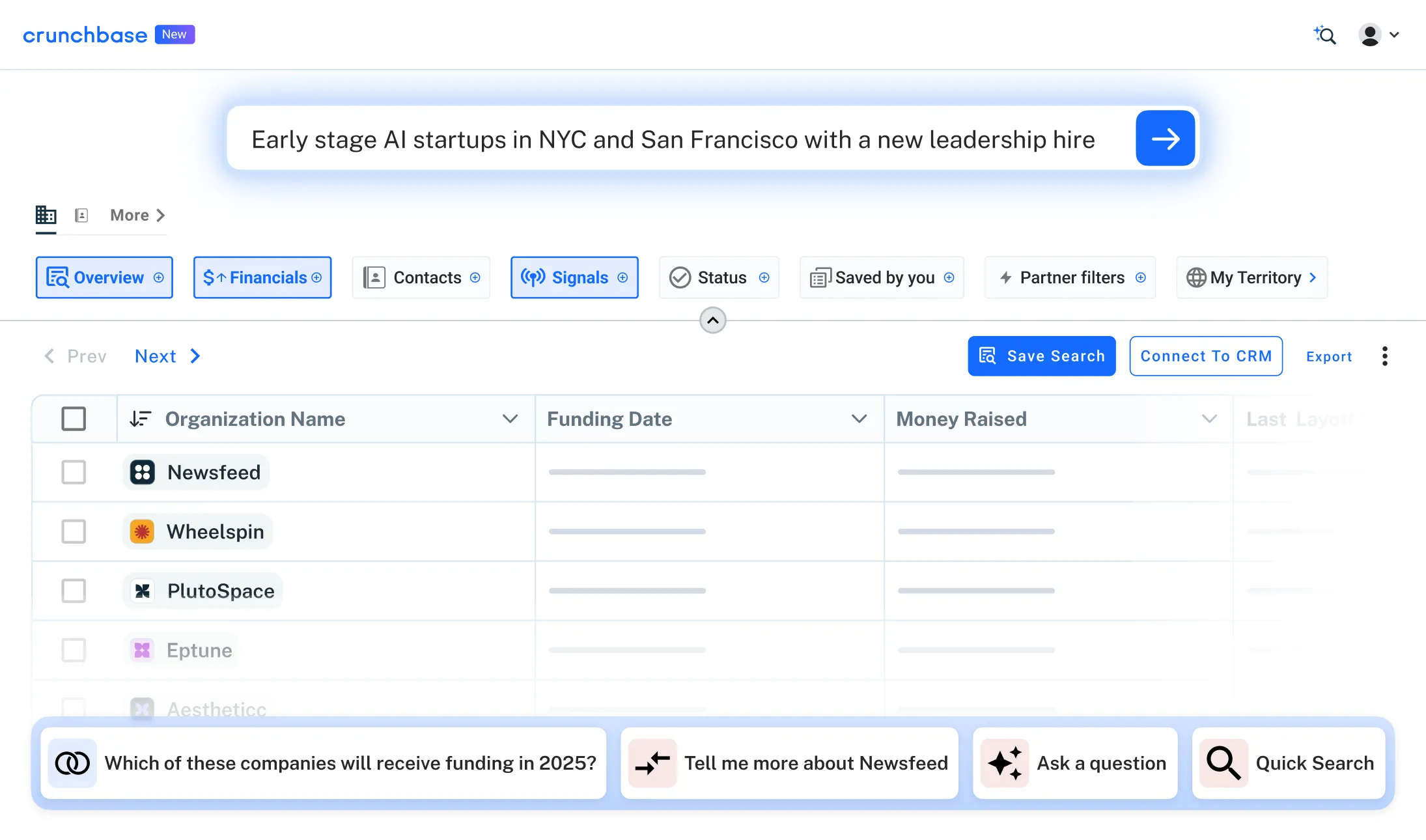
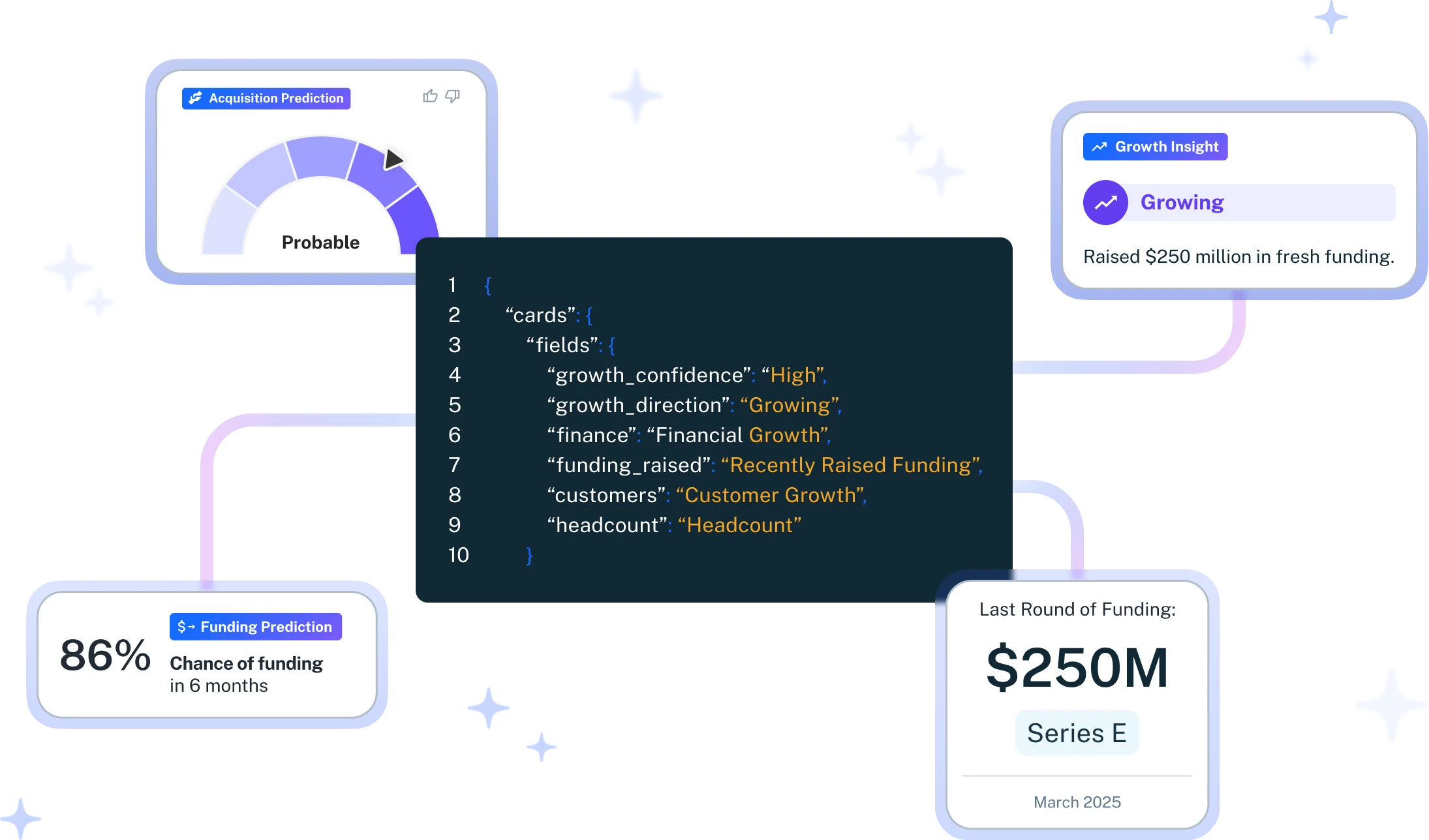
Crunchbase provides licensed access to proprietary private company data and predictive intelligence through its API, enabling teams to build and scale data-driven products. Its dataset spans millions of public and private companies and includes funding rounds, acquisitions, investors, executive profiles, financial signals, and predictions about future company behavior.
Product builders use Crunchbase data to power features such as searchable company profiles, market and ecosystem mapping, investment insights, risk indicators, and predictive analytics surfaced directly to end users. Rather than investing heavily in collecting, validating, and maintaining private company data internally, teams license Crunchbase data to accelerate development while keeping their products current as markets evolve.
By combining best-in-class proprietary data with live updates and forward-looking predictions, Crunchbase gives product teams the flexibility to expand feature depth, enter new markets, and support new customer use cases over time.
Custom pricing based on data scope and licensing requirements. Get a quote by contacting the Crunchbase team.
Best for: Financial account and transaction data
Plaid provides secure, permission-based access to consumer and small business financial data. Through its APIs, applications can connect to bank accounts, credit cards, and financial institutions to retrieve balances, transactions, and identity attributes. Plaid’s data infrastructure is widely used across fintech, lending, and financial management use cases where accuracy and timeliness are critical. Its emphasis on consent and security has made it a foundational provider in regulated financial environments.
Usage-based pricing, typically per connected account or data product.
Best for: B2B intent data
Bombora specializes in intent data derived from aggregated content consumption across a large network of B2B publishers. Its data identifies companies that are actively researching specific topics, products, or services, offering insight into emerging demand. Organizations use Bombora to understand market interest trends and prioritize outreach or analysis based on buying signals. The data is particularly valuable for interpreting interest before formal purchase activity occurs.
Subscription-based pricing.
Best for: Location and mobility data
Foursquare provides geospatial and foot-traffic data derived from mobile location signals. Its datasets help organizations understand where people go, how locations perform, and how physical movement translates into behavior. The data is commonly used in retail analytics, real estate analysis, advertising measurement, and urban planning. Foursquare emphasizes aggregated, privacy-conscious insights rather than individual-level tracking.
Custom pricing based on data volume and use case.
Best for: Market research and benchmarking data
Aberdeen is a data supplier that provides industry benchmarks, research insights, and performance data across business functions such as sales, marketing, operations, and technology. Its datasets help organizations compare performance against peers and identify best practices across industries. Aberdeen’s research is often used to inform strategy, planning, and investment decisions. The data is typically consumed as part of ongoing subscription access.
Subscription-based pricing.
Best for: Identity, credit, and risk data
Experian is a global data provider focused on consumer and business credit, identity verification, and fraud prevention. Its datasets are widely used in financial services, insurance, and other regulated industries where trust and compliance are essential. Experian combines large-scale data assets with analytics to support decisioning and risk assessment. The company’s data is often embedded directly into underwriting, verification, and compliance workflows.
Custom enterprise pricing.
Best for: Website and technographic intelligence
BuiltWith analyzes websites to identify the technologies they use, such as hosting providers, frameworks, analytics tools, and third-party services. Its data helps organizations understand technology adoption patterns across the web. BuiltWith is commonly used for market analysis, competitive research, and infrastructure mapping. Historical tracking allows users to see how technology stacks change over time.
Tiered subscription pricing.
Best for: Account-based intent and buying signals
6sense uses AI and behavioral data to identify which companies are actively researching solutions and where they are in the buying journey. Its data helps organizations understand demand patterns at the account level rather than relying on individual leads. By combining intent signals with firmographic and predictive models, 6sense provides insight into purchasing readiness. The data is often used to align sales and marketing strategies.
Enterprise subscription pricing.
Best for: Large-scale data engineering and machine learning
Databricks is a data and AI platform designed to process, analyze, and model large volumes of data across cloud environments. Built on Apache Spark, it enables organizations to unify data engineering, analytics, and machine learning workflows within a single platform. While Databricks does not sell proprietary datasets, it plays a critical role in how licensed and internal data is transformed, enriched, and operationalized. Many organizations rely on Databricks to build predictive models and advanced analytics on top of third-party data.
Usage-based pricing tied to compute and workloads.
Best for: Account-based intelligence and advertising data
Demandbase provides account-level data and analytics to support account-based marketing and advertising strategies. Its datasets help organizations identify target accounts, personalize engagement, and measure account performance across channels. Demandbase combines intent, firmographic, and engagement data to create a unified view of accounts. The platform is widely used by B2B organizations managing complex sales cycles.
Custom subscription pricing.
Best for: SaaS stack intelligence
G2 Stack is a data vendor that provides visibility into the software tools used by organizations, based on public signals and usage data. Its insights help teams understand software adoption trends and competitive positioning across markets. The data is often used for market mapping and ecosystem analysis. G2Stack focuses on identifying how companies build and manage their technology stacks.
Subscription pricing.
Best for: Cloud-native data warehousing and data sharing
Snowflake is a cloud data platform built for scalable storage, analytics, and secure data collaboration. It allows organizations to centralize data and perform analytics without managing underlying infrastructure. Through Snowflake Marketplace, teams can license and access third-party datasets directly within their environment. This approach simplifies how external data is consumed, governed, and combined with internal data at scale.
Consumption-based pricing for storage and compute.
Best for: IP intelligence and geolocation data
IPQwery provides IP address data that maps internet traffic to geographic and network attributes. This data is used for personalization, localization, fraud prevention, and security analysis. IPQwery’s datasets help organizations understand where traffic originates and how networks are structured. The data is typically consumed through APIs or bulk access.
Tiered or usage-based pricing.
Best for: Healthcare-focused business intelligence
Ampliz provides datasets covering companies and professional contacts across industries. Its data supports market analysis, segmentation, and outreach by helping organizations understand company structures and key decision-makers. One of its offerings is Ampliz Healthcare Intelligence, which provides contact and business intelligence on healthcare providers and organizations to support sales, marketing, and recruitment in healthcare.
Subscription pricing.
Best for: Technographic intelligence
Datanyze tracks the technologies companies use across their digital infrastructure. Its data helps organizations understand adoption trends and identify markets based on technology usage. Datanyze is often used for research, segmentation, and competitive analysis. Historical data allows users to observe changes in technology stacks over time.
Subscription pricing.
Best for: Event and intent data
TAGX is a data provider that offers data related to industry events, conferences, and attendee engagement. Its datasets help organizations understand interest signals tied to event participation. TAGX data is often used to identify emerging demand around specific topics or industries. The focus is on event-driven insights rather than ongoing behavioral tracking.
Subscription pricing.
Best for: Web automation and data extraction
OpenWeb Ninja provides tools for extracting structured data from public websites at scale. Its platform supports custom data collection workflows for organizations that need bespoke datasets. OpenWeb Ninja is commonly used when off-the-shelf datasets are unavailable. The data can be exported in structured formats for analysis or integration.
Usage-based or subscription pricing.
Best for: Agricultural and commodity market data
Expana delivers pricing, supply, and market intelligence across agriculture and commodity markets. Its data helps organizations track price movements, supply dynamics, and market trends. Expana serves producers, traders, and analysts who need timely commodity insights.
Subscription pricing.
Best for: Construction and infrastructure project data
Dodge Construction Network provides detailed data on construction projects, bids, and industry activity. Its datasets are used to analyze construction pipelines, forecast demand, and understand regional trends. Dodge data is widely used by construction firms, manufacturers, and analysts. The focus is on project-level visibility and market intelligence.
Subscription pricing.
Best for: Property and real estate data
ATTOM is a data vendor that provides comprehensive property data across the United States, including ownership, mortgage, tax, and valuation records. Its datasets support real estate analysis, housing market research, and financial modeling. ATTOM aggregates public records into standardized, usable formats. The data is accessed via APIs or bulk licensing.
Custom or tiered pricing.
Best for: Experimentation and product analytics
Statsig supplies tools and data for feature experimentation, testing, and product analytics. Its platform helps organizations measure how changes impact user behavior and outcomes. Statsig emphasizes statistically rigorous experimentation at scale. The data supports continuous optimization of digital experiences.
Usage-based pricing with free tiers.
Best for: Restaurant and food data
MealMe aggregates restaurant menus, pricing, and availability across delivery platforms. Its data helps power food discovery, ordering, and analytics experiences. MealMe focuses on keeping menus and pricing current across fragmented sources.
Custom pricing.
Best for: Consumer spending and transaction insights
ConsumerEdge is a data supplier that offers anonymized transaction data used to analyze consumer spending behavior. Its datasets help organizations understand demand trends across industries and geographies. ConsumerEdge focuses on aggregated insights rather than individual-level data. The data supports market analysis and economic research.
Enterprise pricing.
Best for: Consumer behavior data
MFour is a B2B data provider that collects consumer insights through mobile surveys and behavioral research. Its data helps organizations understand preferences, sentiment, and decision-making patterns. MFour emphasizes real-time data collection from mobile audiences. The data is often used for market research and brand analysis.
Project-based or subscription pricing.
Best for: E-commerce and digital performance intelligence
WiserBrand is a data-driven intelligence provider focused on e-commerce, digital performance, and competitive pricing insights. The company aggregates and analyzes data related to online pricing, product availability, SEO performance, and digital market dynamics to help organizations understand how brands compete and perform across online channels. WiserBrand’s data is used for competitive analysis, pricing strategy, and digital optimization, particularly in retail and e-commerce contexts.
Custom pricing.
Best for: Financial data on privately held companies
PrivCo focuses on financials, ownership structures, and valuation estimates for private companies. Its data is commonly used for research, due diligence, and market analysis. PrivCo aggregates information from public filings, proprietary research, and modeling. The dataset fills gaps where private company transparency is limited.
Subscription pricing.
Best for: Web and mobile app traffic data
Similarweb provides licensed data and insights into website and mobile app traffic, engagement patterns, referral sources, and audience behavior across the global internet. Its datasets are built from a combination of aggregated signals, partnerships, and modeling techniques that estimate how users discover and interact with digital properties. Organizations use Similarweb data to analyze market share, benchmark digital performance, and understand competitive dynamics online. The data is commonly applied in market research, investment analysis, and digital strategy.
Subscription-based pricing, with tiers based on data depth and access level.
Data vendors support a wide range of business, analytical, and operational needs across industries. While the specific datasets vary — from financial transactions to location signals to company intelligence — the underlying use cases tend to fall into a few core categories.
Across all of these scenarios, data vendors reduce the cost, time, and complexity of collecting and maintaining high-quality datasets, allowing teams to focus on analysis and decision-making rather than raw data acquisition and upkeep.
When licensed data becomes part of a product’s core functionality, proper evaluation is key.
Data accuracy, depth, and freshness determine whether your product can handle edge cases, new markets, and emerging companies without manual intervention. Structure and normalization affect how easily data can be integrated into product architectures and extended to support new features.
API quality and reliability are critical for production use, especially when data is surfaced directly to customers. Clear documentation, stable schemas, and predictable performance reduce engineering overhead and risk.
Finally, licensing terms and scalability matter. The right data vendor should make it easier — and more cost-effective — to ship new features over time by providing data and predictions that scale with customer demand and product growth.
There is no single best data vendor for every scenario. However, for teams building products that rely on private market intelligence delivered through licensed, production-ready data, Crunchbase stands out.
Crunchbase combines proprietary data, AI-powered predictions, and an API designed to power both internal models and customer-facing products. Instead of limiting teams to static datasets, it enables continuous product enhancement — supporting deeper insights, new use cases, and new revenue opportunities as products scale.
For product developers looking to build quickly while maintaining flexibility to scale, Crunchbase offers a trusted, durable data foundation that compounds in value over time.
A data vendor is a company that aggregates, structures, and licenses datasets sourced from multiple inputs, such as public records, proprietary collection, partnerships, or modeling. Data vendors focus on transforming raw or fragmented information into reliable, usable data related to markets, consumers, industries, or behavior. Their role is to make large-scale data accessible and actionable without requiring organizations to build and maintain their own data pipelines.
A B2B data provider is a company that supplies data about businesses, markets, or professional activity for use by other organizations. B2B data providers typically offer firmographic, financial, intent, technographic, or predictive data to support research, analytics, sales, product development, and strategic planning. Their data helps organizations understand companies, industries, and commercial dynamics at scale.
There is no single data provider that fits every use case, but some are widely recognized leaders within specific categories. For company and market intelligence, Crunchbase is among the most popular and trusted providers, with nearly two decades of experience aggregating hard-to-find private company data. Its long-standing focus on private markets, combined with broad global coverage and continuous data validation, has made it a go-to source for organizations across sales, research, analytics, investment, and product use cases.
Learn more about how the Crunchbase API can power your products and help your business scale.
Organizations use B2B data vendors to access high-quality, hard-to-source datasets without building and maintaining them internally. Data vendors offer broader coverage, regular updates, and specialized data collection methods that reduce time to insight and operational overhead. By licensing external data, teams can make more informed decisions, scale faster, and focus internal resources on analysis rather than data gathering.
When choosing a data vendor, organizations should evaluate data coverage, accuracy, freshness, and relevance to their specific use cases. Licensing terms, scalability, and permitted usage are also critical. Additionally, teams should consider how the data is accessed, how often it’s updated, and whether the vendor can support long-term growth and evolving needs.
Data from vendors is typically accessed through APIs, bulk file delivery, cloud marketplaces, or direct data integrations. APIs support real-time or recurring access, while bulk files are often used for large-scale analysis or modeling. Some vendors also distribute data through cloud platforms, allowing organizations to query licensed datasets directly within their existing data environments.
Interested in exploring the Crunchbase API for your own models and tools? Contact the Crunchbase team for a quote.
.webp)