Best Predictive Intelligence Software in 2025

7 min read
.svg)



The ability to see around corners and move quickly has always separated the businesses that lead from those that fall behind. In 2025, predictive intelligence has become the solution that enables companies to emerge as winners.
Predictive intelligence is the use of AI-powered models and data to anticipate future events, trends, and behaviors — turning signals into actionable foresight before outcomes occur. Businesses in all industries are increasingly relying on AI-powered predictions to guide questions such as where to invest and which customers to target, so they can get their foot in the door before competitors.
The predictive analytics market — which includes predictive intelligence and other forecasting tools — is expected to grow to $28.1 billion by 2026. McKinsey estimates generative AI to deliver a total of $2.6 trillion to $4.4 trillion in economic benefits annually when applied across industries. The message is clear: AI technologies like predictive intelligence are no longer optional — they’re foundational.
With that in mind, here are 20 companies at the forefront of predictive intelligence in 2025.
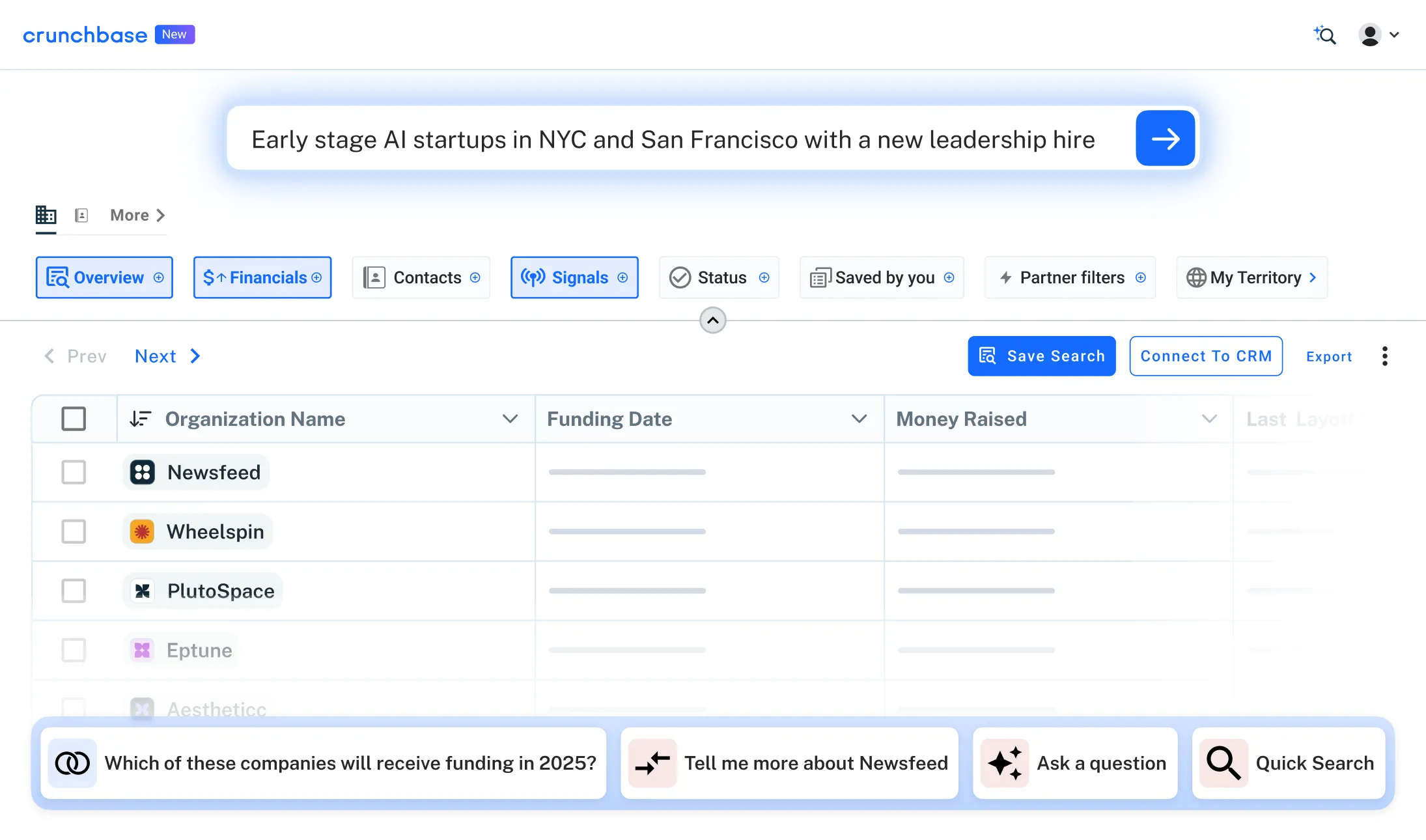
Crunchbase is a predictive intelligence solution that enables organizations to stay ahead of private market shifts and seize emerging opportunities early. It does this by offering company predictions like:
Crunchbase helps anyone looking to spot emerging opportunities first and close deals ahead of peers — whether they’re investors, wealth management firms, sales or marketing teams, or market analysts. Its strength lies in a rare combination of best-in-class private company data, advanced AI models, and engagement signals from 80M+ users worldwide. With powerful data that is analyzed and extrapolated by proprietary AI technology, Crunchbase is able to deliver unmatched foresight into what’s likely to happen next.
Crunchbase’s predictive intelligence is available in two ways: through the Crunchbase Business software, or via the Crunchbase API for those looking to integrate predictive data into their existing models, products, and tools.
IBM Watson Studio remains one of the most established names in enterprise AI. Its predictive intelligence software combines automated machine learning, explainable AI, and integration with IBM Cloud services. Enterprises use Watson to build and deploy predictive models that guide decisions in healthcare, financial services, and supply chain management. Watson’s emphasis on trust and transparency makes it especially valuable for regulated industries.
Google’s Vertex AI platform provides advanced tools for predictive intelligence, including AutoML for rapid model development and explainable AI features. Organizations rely on Vertex AI to forecast demand, predict churn, and identify anomalies across vast datasets. Its seamless integration into Google Cloud means enterprises can unify predictive models with their existing data infrastructure, making it a natural fit for companies already operating in the Google ecosystem.
Microsoft’s Azure Machine Learning offers an end-to-end analytics environment. Enterprises use it for everything from demand forecasting to predictive maintenance. Because it integrates tightly with Microsoft’s suite of productivity and enterprise tools, Azure ML is particularly valuable for organizations that want predictive capabilities woven directly into existing business workflows.
SAS has been a leader in statistical modeling and analytics for decades, and its modern platforms extend that expertise into predictive intelligence. Financial institutions, healthcare providers, and government agencies continue to use SAS to forecast risk, detect fraud, and model outcomes. Its reputation for reliability and robustness keeps SAS central to many data science teams.
DataRobot specializes in automated machine learning, making predictive intelligence more accessible to non-technical users. Companies turn to DataRobot to build and deploy predictive models quickly, without requiring deep data science expertise. The platform’s emphasis on explainability also gives executives confidence in AI-driven forecasts.
H2O.ai offers an open-source machine learning platform alongside its commercial Driverless AI product, which streamlines predictive model development. Enterprises adopt H2O.ai to forecast outcomes in finance, healthcare, and retail. The platform is popular with both data scientists and citizen analysts because of its flexibility and accessibility.
Amazon Forecast is Amazon Web Services’ fully managed time-series forecasting tool. Organizations use it to predict demand, optimize inventory, and allocate resources with greater accuracy. By training on historical data and combining it with related variables like pricing, promotions, or supply chain factors, Forecast generates actionable predictions that improve planning across industries. Its scalability and integration into the broader AWS ecosystem make it a go-to solution for enterprises that want predictive intelligence seamlessly embedded into their cloud infrastructure.
Altair RapidMiner is a predictive intelligence tool that caters to both data scientists and business users. Its visual interface and automation capabilities make it easy to build models that forecast customer behavior, detect risk, and optimize operations. Organizations across sectors—from finance to retail—use RapidMiner to democratize predictive intelligence, enabling more teams to access and act on forward-looking insights without heavy technical overhead.
IQVIA provides predictive intelligence for the healthcare and life sciences industries. Pharmaceutical companies use IQVIA to forecast drug performance and patient outcomes, while healthcare providers use it to anticipate treatment effectiveness and resource demand. IQVIA’s focus on clinical research and patient analytics makes it a leader in healthcare prediction.
SAP has embedded predictive intelligence into its analytics and planning suite, giving enterprises foresight into financial performance, HR planning, and supply chain dynamics. For organizations already reliant on SAP ERP systems, SAP Analytics Cloud provides predictive insights that fit seamlessly into existing operations.
Alteryx simplifies predictive modeling through its intuitive, drag-and-drop interface. Enterprises use it to accelerate workflows, from preparing data to deploying predictive models. Its ease of use makes predictive intelligence accessible to a wider range of business users, particularly those in marketing and operations.
Dataiku blends code-first and visual interfaces, supporting collaboration between technical experts and business teams. Enterprises use Dataiku to forecast sales, predict churn, and model customer lifetime value. Its ability to bridge teams makes it an attractive choice for organizations looking to embed predictive intelligence across departments.
Salesforce Einstein brings predictive intelligence into CRM. Sales teams use it to score leads, forecast pipeline performance, and predict churn. Marketing teams use it to identify high-propensity customers. Because Salesforce Einstein operates directly within the platform, it delivers predictive insights in the flow of work.
Freshworks incorporates predictive analytics into its customer engagement suite, helping companies anticipate customer behavior and optimize outreach. For SMBs and mid-market companies, Freshworks provides an accessible way to add predictive intelligence into CRM and marketing automation.
Anaplan delivers predictive intelligence through its connected planning platform, widely used in finance, sales, and supply chain functions. Businesses rely on Anaplan to model scenarios, forecast revenue, and anticipate workforce needs, allowing leaders to adjust strategies in real time. Its ability to unite predictive modeling with collaborative planning processes makes it particularly valuable for large organizations where foresight needs to translate directly into coordinated action.
Clay automates prospecting and lead enrichment for go-to-market teams. By integrating with Crunchbase’s predictive intelligence, Clay provides private company predictions and insights that help sales teams target the right accounts at the right time. Its platform enables GTM leaders to scale outreach while incorporating predictive signals directly into their workflows.
Cloudera provides predictive intelligence at scale through its hybrid data platform, which supports advanced analytics and machine learning on massive datasets. Enterprises use Cloudera to forecast financial outcomes, optimize customer engagement, and detect operational risks across industries like telecom, financial services, and manufacturing. Known for its open-source roots and enterprise-grade security, Cloudera helps organizations unify data-driven prediction with strong governance.
Snowflake is best known as a cloud data platform, but with partner integrations like Crunchbase, it supports predictive intelligence at scale. Organizations use Snowflake to host predictive models, forecast business trends, and unify insights across datasets. Its ecosystem makes it a flexible foundation for predictive workflows.
Oracle has embedded predictive intelligence within its Fusion Cloud applications, particularly in finance and HR. Companies use it to forecast expenses, model workforce needs, and anticipate customer behavior. Oracle’s strength is in delivering predictive insights within its widely used enterprise software suite.
As markets move faster and competition intensifies, the difference between winning and losing often comes down to foresight. Predictive intelligence is giving organizations that edge.
Among the top companies offering predictive intelligence in 2025, Crunchbase stands out as the leader with its private market predictions. With Crunchbase’s predictive intelligence, professionals have the foresight to move earlier, allocate resources smarter, and maximize revenue.
To explore the right predictive intelligence solution for your business, learn more about Crunchbase Business and the Crunchbase API.
.webp)

.webp)